
Lead with clarity as AI changes your business.
Leaders do not need to know everything happening in AI.
You do need to understand what AI makes possible, decide what should change in your organization, and lead your people through the transition.
Bring the decisions on your desk. We will work through them together.
“Companies with the strongest AI-driven financial outcomes are twice as likely to redesign workflows rather than simply adding AI tools to existing ways of working.”
Source: PwC
Experienced Perspective for the Decisions You’re Making
You are deciding where to invest, what to expect from your people, and how much of the organization’s work to reconsider.
Those decisions keep evolving. A new capability opens up an opportunity. A promising experiment exposes a management problem. Employees move at different speeds. Something that worked three months ago needs another look.
Through ongoing mentoring, we help you examine those developments in the context of your business. We bring current AI knowledge, practical examples, and questions that challenge your assumptions. Together, we work toward decisions you can explain and act on.
Your Business Is the Curriculum
Every mentoring conversation is built around the decisions your leadership team is facing — where AI is creating meaningful leverage, which workflows or teams should be redesigned next, or where individual productivity gains are getting trapped. The questions tend to resolve into a few themes:
- What has AI made possible that was not practical before and what should change because of it?
- Where does human judgment create the most value?
- What work should remain human even if AI could technically perform it?
- What should we start, stop, or redesign?
- What skills will our people need next?
- How should leaders guide teams through repeated changes in how work gets done?
These are leadership questions. AI simply makes them more urgent.
What You Develop as a Leader
We help you and your team develop the following capabilities.
A shared language for discussing AI and work redesign
Better judgment about which AI developments matter
A clearer view of where AI creates business value
Stronger instincts about what should remain human
Greater ability to challenge AI hype without ignoring meaningful change
A repeatable way to reconsider workflows and roles
More informed decisions about tools, investments, and priorities
Greater alignment around how the organization should evolve
Rooted in Teaching, Proven in Practice

Sean Campbell
Co-founder & CEO, Cascade Insights®
Sean Campbell has been passionate about education for as long as he’s been in technology. He’s taught at Purdue University, Willamette University’s MBA program, and currently at George Fox University’s College of Business, where he serves as Director of AI Integration for the MBA program.
That teaching background is central to how Cascade Insights® approaches AI training. The material isn’t built from blog posts and vendor demos — it’s grounded in how the AI landscape is actually changing, how organizations are really adopting AI, and what works when you’re sitting across from someone who needs to make this practical for their job.
Sean has also authored technology books published by Microsoft Press and Intel Press, delivered over 150 conference sessions and workshops, and appeared on more than 100 podcasts.
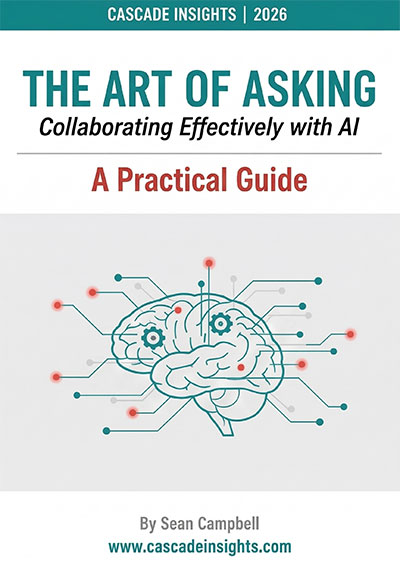
Master the Art of AI Collaboration
As AI gets more capable, the quality of the result depends less on knowing the right prompt and more on knowing how to direct the work. The Art of Asking is our framework for doing that well.
- How to effectively delegate to AI — use the 5-element framework to manage AI like a capable colleague.
- Workflows and agentic use cases — learn to meaningfully manage AI-driven workflows and agents.
- Techniques to create AI champions — build internal champions who help AI adoption stick across teams.