

Marketing is one of the functions most visibly disrupted by AI. Tools that generate copy, design assets, build campaigns, and analyze performance have moved from novelty to standard issue in most B2B marketing stacks. And yet, many marketing teams are not getting meaningfully better results. They’re getting faster output of the same mediocre work.
The problem lies within the training that many marketing teams are receiving. Most training stops at the tool level, teaching marketers what AI can do without helping them develop the judgment to direct it well. The right AI training format for marketing goes deeper: it maps AI capabilities to the actual structure of marketing work, clarifying where automation genuinely helps, where it creates risk, and where human expertise is non-negotiable.
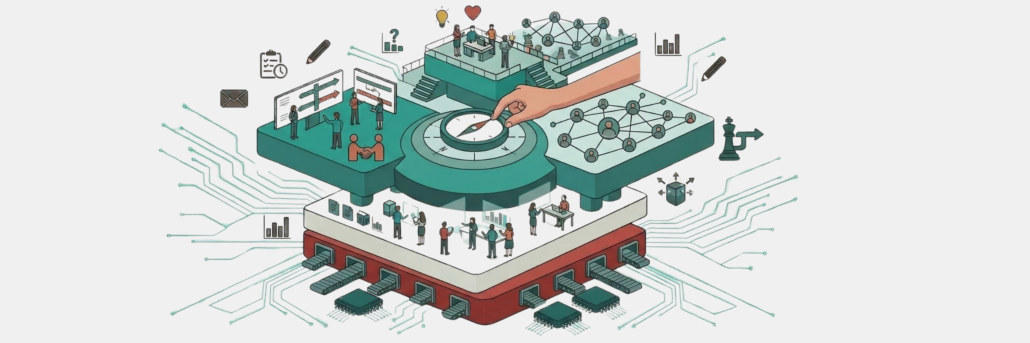
That’s what the RISE Framework provides. Routine, Interpretation, Strategy, Engagement: a map for understanding where AI genuinely helps marketing work, where it creates a false sense of productivity, and where human judgment is not optional. Here’s how it breaks down for marketing specifically, and why it’s become the AI training format marketing leaders at B2B organizations keep coming back to.
Routine: The Work That Should Already Be Automated
Marketing has always had a high volume of repeatable production work, and this is where AI earns its keep without much debate.
What belongs here:
- First drafts of blog posts, social copy, and email sequences
- Resizing and reformatting content for different channels
- Transcribing and summarizing interviews, calls, and webinars
- Pulling performance data into weekly or monthly reports
- Building out variations for A/B tests
- Drafting metadata, alt text, and SEO tags
If your team is still doing these tasks manually, that’s a resource allocation problem. Every hour spent on production work that AI can handle is an hour not spent on the work that actually differentiates your marketing.
The caveat: automating Routine work only pays off if the time genuinely gets redirected. Teams that automate content production and then fill the gap with more content production have not moved up the value chain. They’ve just increased volume.
Interpretation: Where Marketing Teams Are Most Exposed
This is the level where AI is most seductive and most dangerous for marketers.
AI can synthesize campaign performance data, summarize customer interviews, identify patterns in win/loss reports, and generate hypotheses about why a campaign underperformed. It can do all of this quickly and confidently. That confidence is the problem.
Marketing data is rarely clean. Attribution is contested. Sample sizes for qualitative research are small. Seasonal effects overlap with campaign effects. A platform algorithm change can look like a messaging problem. AI doesn’t know any of this unless you tell it, and even then, it tends to produce analysis that sounds authoritative regardless of how solid the underlying evidence actually is.
The marketers who use AI well at this level bring discernment to the output, not just curiosity. That means asking:
- What data is this interpretation actually based on, and how reliable is it?
- What context does the AI not have that would change this conclusion?
- Is this pattern real, or does it reflect a gap in how we’re measuring?
AI can tell you that email open rates dropped 12% last quarter. It cannot know that your sales team changed their outreach cadence at the same time, contaminating the data. The marketer who catches that is adding value. The marketer who passes the AI’s interpretation directly into a strategy deck is creating risk.
Where most marketing teams are stuck: over-relying on AI-generated interpretation without applying the institutional knowledge and skepticism that makes analysis actually trustworthy.
Strategy: The Level Where Marketing Earns Its Seat at the Table
This is where the gap between marketing teams that use AI well and those that don’t becomes most visible to the rest of the organization.
AI can generate positioning frameworks, suggest go-to-market approaches, produce competitive analyses, and outline messaging architecture. In the hands of a marketer who knows how to direct it, this is genuinely useful. It compresses the time between a blank page and a working draft.
But positioning is not a content problem. It’s a strategic judgment call about which customers you are choosing to serve, which problems you are claiming to solve better than anyone else, and which tradeoffs you are willing to make. AI can surface options. It cannot make that call, and it cannot defend it when a VP of Sales pushes back in a quarterly business review.
The same applies to campaign strategy, budget allocation, and channel prioritization. These decisions require someone who understands the business well enough to put their name behind a direction and adjust when reality diverges from the plan.
The opportunity: marketers who use AI to accelerate the analytical groundwork — competitive research, audience segmentation, message testing hypotheses — free up their own time for the strategic synthesis that actually requires them. That’s the version of AI-assisted marketing that makes a function more valuable, not just more productive.
Engagement: The Part of Marketing AI Cannot Replace
The highest-value marketing work has always been relational, and that has not changed.
Understanding what a customer actually means when they describe a problem in their own words. Building enough trust with a sales team that they use the materials you create. Interviewing a subject matter expert in a way that draws out insight they didn’t know they had. Presenting a research-backed strategy to a skeptical executive. Knowing when a piece of content is going to land and when it’s going to miss, not because of the data, but because of an intuition built from years of watching audiences respond.
AI cannot replicate any of this. It can support it. A marketer who uses AI to prepare for a customer interview, synthesize notes afterward, and draft follow-up content is a more effective version of themselves. But the conversation, the relationship, and the judgment call about what it all means still belong to them.
This is also where brand voice lives, not in a style guide, but in the accumulated decisions a team makes about what they will and won’t say, how they handle a difficult topic, and what they choose to stand for. AI can be trained to approximate a brand voice. It cannot be trusted to protect one.
Where Most B2B Marketing Teams Actually Are
Honest assessment: most B2B marketing teams have adopted AI heavily at the Routine level, inconsistently at the Interpretation level, and barely at all in ways that free up time for Strategy and Engagement.
The result is more content, faster. Not better marketing.
The teams pulling ahead are not producing more. They’re producing more deliberately, with AI handling the volume and humans owning the judgment. That requires a deliberate approach to reskilling, not just tool access, but a shared understanding of where human expertise is non-negotiable and where it’s being wasted on work a well-directed AI could handle.
Is your marketing team working at the right levels?
At Cascade Insights®, our AI Training & Mentoring programs are built around an AI training format for marketing teams that goes beyond tool tutorials. We help B2B marketing teams build the skills to direct AI effectively, apply the right level of scrutiny to AI-generated interpretation, and protect the strategic and relational work that actually moves the needle.