
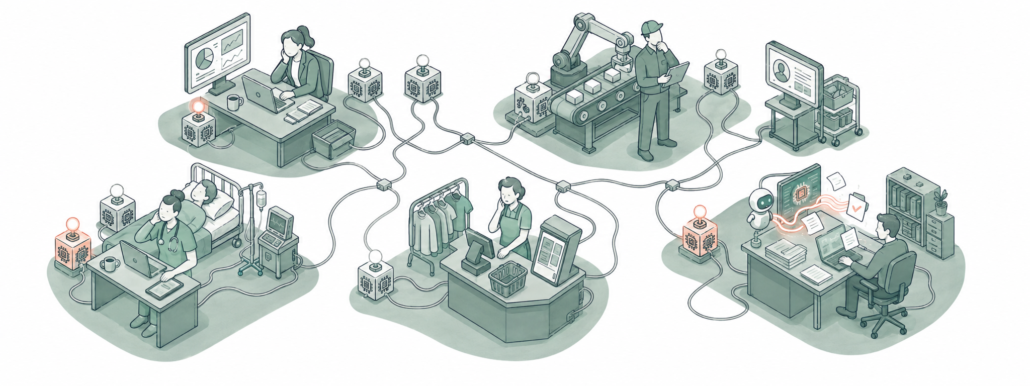

Eighty-five percent of employees now have access to AI tools at work. Only 25% actually use them regularly. That’s a 61-point gap, and it’s one of the most consistent findings across every industry the study covered: financial services, manufacturing, healthcare, retail, professional services. Different sectors, same story.
Atlassian’s 2026 research puts a similar number on it from the inside: 85% of knowledge workers already use AI, but only 6% of executives can point to organization-wide ROI. Access has become the easy part. Impact has not followed.
Most leaders read that number and think about deployment: which tools are rolled out, how many seats are filled, whether the dashboard shows usage trending up. That instinct is understandable. It is also exactly what keeps the gap open.
Access turned out to be the easy problem to solve. Building meaningful AI use is the one still open.
Why “Access” Became the Wrong Thing to Measure
Somewhere in the last two years, “AI adoption” quietly got redefined as “AI availability.” Companies bought licenses. They ran onboarding sessions. They stood up a Slack channel for prompt tips. All of that produced a number, a login count, a seat utilization rate, and that number became the proxy for progress.
A login is not a behavior change. An employee who opens a tool once to satisfy a rollout survey looks identical, on a usage dashboard, to an employee who has fundamentally changed how they approach their work. Deloitte’s 2026 State of AI in the Enterprise report found that among workers who already have access, fewer than 60% use AI in their daily workflow, and that share has barely moved year over year. Worker access rose sharply. Genuine use did not follow at anywhere near the same pace.
This is the gap that matters, and closing it comes down far less to technology than to how the work itself is designed.
What’s Actually Driving the Gap
The reasons employees stall out after gaining access are remarkably consistent across research firms, industries, and geographies:
The tools don’t fit the workflow.
Most AI deployments get layered onto existing processes rather than built around how work actually happens. If a process was slow or clunky before AI arrived, bolting a chatbot onto it does not fix that; it just produces the same bad process, faster. Atlassian’s own research makes this point directly: organizations that see the strongest AI returns aren’t the ones adding AI on top of their workflows, they’re up to 3.5 times more likely to have actually reinvented how the work happens, with new tools and new routines.
Nobody has answered “where does this help me, specifically?”
Generic training sessions teach people how a tool works in the abstract. They rarely connect that capability to the concrete tasks sitting on someone’s desk that afternoon. Without that translation, employees default back to the way they already know how to do the work.
Trust and risk are unresolved.
Employees who are unsure whether AI output is reliable, or who fear the professional consequences of an AI-assisted mistake, quietly opt out. This shows up more, not less, in roles with real accountability attached to the work. It’s also a bigger problem than most leaders realize: Atlassian found that colleagues who disclosed using AI on a project were rated as far lazier than peers evaluated on the exact same work, unless the organization’s culture actively celebrated AI use. Silence around AI use isn’t caution. It’s often a rational response to a culture that quietly penalizes it.
Training happened once, and then stopped.
Education remains the most common response to the adoption gap, and it is also the response that has moved the needle the least. A single onboarding session cannot keep pace with how quickly the tools, and the expectations around them, are shifting. This pattern shows up in how companies actually spend, too: Atlassian’s research found executives are 84% more likely to invest in new AI technology than in developing their teams’ AI skills. Nearly all of that spending targets tools, leaving skill-building as an afterthought.
None of these four causes is a tooling problem. All four are organizational. And that is precisely why more licenses, better tools, or another round of training rarely closes the gap on their own.
Meaningful AI Use Is a Different KPI Than Adoption
If access isn’t the right thing to measure, what is?
Meaningful AI use looks less like a login count and more like a change in output. It shows up when an employee’s default way of approaching a task has actually shifted, not because they were told to use the tool, but because they have experienced a better way of working and have no interest in going back. It shows up when the quality bar for what a senior professional is expected to produce has moved, and AI is genuinely part of how that bar gets met. It shows up in outcomes: faster cycle times, better-informed decisions, work that has been redesigned rather than merely accelerated.
That distinction is not semantic. An organization optimizing for access will keep buying tools and keep watching usage numbers plateau. An organization optimizing for meaningful use asks a fundamentally different question: what needs to change about the work itself before AI can matter here.
AI Adoption Belongs to the C-Suite, Not IT
One of the clearest patterns in Atlassian’s report is where responsibility for AI adoption tends to sit, and where it needs to sit instead. Only 37% of knowledge workers think their organization effectively balances the technology side of AI with the people side. That imbalance often starts with an org chart problem: AI gets handed to IT as a deployment task, while the actual behavior change it requires, new workflows, new trust, new norms, has no clear owner at all.
Atlassian’s fix was structural. The company expanded its Chief People Officer role into a Chief People and AI Enablement Officer, moving AI transformation out of a pure technology function and into the group that owns how work actually gets done across the business. In the words of that officer, Avani Prabhakar: the biggest barrier to AI adoption comes down to mindset, trust, behaviors, and confidence, far more than access to models or tools.
That’s a people problem wearing a technology costume, and it’s exactly why leaving AI adoption to IT alone rarely closes the gap. IT can deploy a tool. It generally can’t redesign how a sales team runs a deal cycle, how a support team escalates a case, or how a legal team reviews a contract. Closing the adoption gap requires someone with a mandate across all of that, not just a mandate over software licenses.
Why Betting on a Single AI Model Is a Mistake
There’s a second structural decision that quietly shapes whether AI use ever becomes meaningful: which models an organization builds around, and how many.
Atlassian’s approach is deliberately model-agnostic, and the logic behind it is worth borrowing. Model capability shifts constantly, and no single provider stays ahead indefinitely. Betting an entire AI strategy on one model creates a dependency that a faster-moving competitor, a pricing change, or a new release cycle can undercut overnight. Atlassian instead runs a range of tools side by side, including Claude Code, Codex, and Gemini, and connects each of them into the same underlying layer of institutional knowledge.
That underlying layer, not the model sitting on top of it, is where Atlassian argues the real competitive advantage lives. Its own formula for this is blunt: intelligence multiplied by context equals acceleration. A frontier model with no knowledge of a company’s history, decisions, or workflows still produces generic output. The same model connected to that institutional context becomes something else entirely. Gating an entire AI strategy on one model’s roadmap misses where the advantage actually sits.
For most organizations, this doesn’t mean building Atlassian’s exact infrastructure. It does mean the question “which AI tool should we standardize on” is often the wrong question. The better one is what institutional knowledge, context, and workflow structure any tool would need access to in order to be useful, since that’s the layer that survives a model swap and the tooling underneath it usually doesn’t.
What Closing the Gap Actually Requires
Here is where most organizations get stuck, and it is worth naming directly: leaders trying to close the adoption gap usually do not actually know why their own employees aren’t using the tools they’ve been given. They have license counts. They have usage dashboards. What they don’t have is visibility into the specific friction points inside specific teams: which workflows the tools don’t fit, which roles still lack a clear translation from “AI can do this” to “this is what changes for you,” where trust breaks down and why.
Guessing at the cause and rolling out a generic fix is how organizations end up running the same “more training” playbook that has already failed to move the needle industry-wide.
Once the diagnosis is right, the fix tends to follow a consistent pattern across the organizations that are pulling ahead:
- Workflow redesign, not workflow addition. AI gets built into how the work is structured, not bolted onto the process that already existed.
- Role-specific translation. Every function gets a clear, concrete answer to “where does this help me,” not a generic capability demo.
- Visible leadership use. Employees adopt new tools faster when they see leadership modeling the behavior, not just mandating it.
- Ongoing measurement and feedback, not a one-time rollout followed by a static usage report six months later.
None of this is complicated in concept. It is, however, specific, and specificity is exactly what generic rollouts and one-size-fits-all training programs cannot deliver.
From Local Gains to Institutional Advantage
Harvard Business School’s Dr. Karim Lakhani put it sharply: the organizations that benefit most from AI won’t be the ones chasing the biggest tool count. Their edge comes from building operating models capable of “turning local gains into institutional advantage.”
That’s the real finish line. Not another pilot. Not another license. An operating model built around how your specific teams actually work, so isolated wins stop staying isolated. It’s the same conclusion Atlassian reached from the inside: models come and go, but the institutional knowledge only your teams hold is what actually compounds.
Before you launch another training push or renew another batch of licenses, it’s worth sitting with three questions:
- Pick one team with strong AI access. What work has actually changed there, task by task, versus what still gets done exactly the way it did two years ago?
- Of what hasn’t changed, is that because AI genuinely doesn’t help there, or because nobody redesigned the workflow to let it?
- What would you expect to be different, in concrete terms, twelve months from now, if AI use in that team became truly meaningful, not just more frequent?
If those questions are harder to answer than you’d like, that’s useful information, not a bad sign. It means the gap is diagnosable, and diagnosable gaps are closeable.
That diagnosis is exactly where our AI Advisory Services start. We don’t lead with a tool recommendation or a training deck. We start by finding out where your specific gap actually lives, which teams have access but not adoption, which workflows are the real bottleneck, and why, then bring the skills, systems, and embedded leadership to redesign the work itself and build the measurement approach that tells you whether use is becoming meaningful, not just whether seats are being filled.
If your organization has access to AI but hasn’t seen the shift in how work actually gets done, we should talk. Get in touch with our team.