

Sean Campbell, CEO of Cascade Insights®, writes about AI and the people who use it in his LinkedIn newsletter, The Human Side of AI. Subscribe there to get each new edition.
I’ve been building a database of public CEO emails and posts about AI-focused staff reductions and org changes for a while now, going back nearly two years at this point. Each announcement describes a different situation, but from an employee’s perspective, one thing tends to be missing from all of these emails, LinkedIn posts, and X posts: What happens to me (as an employee) if this works?
As a business owner, I get the excitement that AI use generates. Something that used to take a week might take a day. A project you couldn’t justify doing becomes possible. Your team can take on work that would have required people or resources you didn’t have.
But put yourself in the employee’s position for a minute. Your team helps you figure out how to do a substantial part of your company’s work in a lot less time. What happens next? Do they get to take on something more interesting? Does the company expect more of the same work? Or has your team merely demonstrated that you can get more done with less, meaning fewer people?
I don’t think those are unreasonable questions. And I don’t think answering them means a leader has to become less excited about AI. It does mean we need to spend more time on what we’re asking people to help build, and where they fit once we’ve built it.
What I’m seeing in these announcements
Shopify’s Tobi Lütke made the expectations clear in an announcement he shared a while back. Effective AI use became part of the job, including for executives. AI use would factor into performance reviews, and teams would need to explain why AI couldn’t meet a need before asking for more people or resources. His memo also pointed employees toward tools and ways to share what they were learning. There was support alongside the expectation.
HubSpot CEO Yamini Rangan’s recent announcement described a different situation. In announcing a reorganization and job reductions, she explained the company’s shift toward delivering customer outcomes with AI. She also explicitly said the reductions were not driven by AI-related efficiencies. The message included the criteria used to assess roles and the support available to departing employees. That raises another issue for me. Your specific work doesn’t have to be automated for your role to change. The company might be changing what it sells, how teams are organized, or which capabilities it needs. You can be good at your job and still find yourself wondering where that job fits in your company, months or years from now.
In his announcement, Box’s Aaron Levie addressed something else I’d want to know as an employee: where the gains go. His stated principles included primarily reinvesting AI savings within the same organization for more strategic work, along with helping employees develop their AI skills. That gives people a more concrete explanation of what the company intends to do with the improvements they help create.
There are meaningful differences across all the CEO announcements I’ve tracked. These leaders are making different decisions, and some are more specific about particular commitments than others. A public memo also won’t tell us about every conversation happening inside a company. But one question runs through all of this that I think deserves more attention: as we ask more from employees in an AI-infused world, what are we committing to in return as leaders?
People have an idea of the deal
Someone joins your company, learns the work, gets better at it, and builds a reputation for doing it well. Along the way, they develop an idea of how things work around your company: what gets rewarded, what leads to more responsibility, and what the company values about their contribution. Some of that is written down. Some comes from what managers have said and what the company has done over time.
Denise Rousseau’s research on the psychological contract gets at this: the obligations people believe they and their employer have to each other. Those beliefs don’t necessarily match management’s understanding, which is to be expected, since two different parties will have two different perceptions of what’s going on and what needs to be done.
Now introduce AI. The expertise someone spent years developing may still matter, but the company wants them to use it differently. Perhaps they’re being asked to help automate work they were previously rewarded for doing themselves.
I think that can be a reasonable request. I also think it calls for a conversation about what comes next. If I help redesign this process, what new responsibilities could I take on? Will I have time to learn them? What will count as doing a good job? And if the company needs fewer people, how will those decisions be made? A speech about productivity leaves those questions open. So does “Don’t worry, this is just a tool,” if you already know the work is going to change substantially.
As leaders, we may not be able to promise that every role will remain. If competitors can deliver comparable work faster or at a lower cost, the business has to respond, if only to ensure that the people who remain work within a sustainable or growing business. But we still make choices about what to pursue, where to invest, and how to handle the consequences for our teams. And I think we need to be as clear about those choices as we are about the need for everyone to adapt.
Fairness has to show up in the decisions
Here’s another way to think about it. Someone can agree that the company needs to change and still think a particular decision was handled badly. Maybe the criteria keep shifting. Maybe the people doing the work weren’t asked about an assumption that drove the decision. Maybe leadership promised one use for the savings and then chose another.
Organizational justice research gives us a useful way to sort through this. It examines fairness in outcomes, the process used to make decisions, the explanations people receive, and the way they are treated. Applied here, I’d want to know who gets the benefits and who bears the costs. I’d want to understand how decisions are made and whether employees can raise information that might change them. And I’d want people to receive a clear explanation and be treated with respect throughout.
A considerate email matters. So does what happens after people read it. If we expect people to learn, we should explain when that learning will happen and what comes off their plate to make room for it. They need access to the tools and someone to work through problems with. Giving someone a license and adding “learn AI” to an already full week leaves a lot for them to figure out.
We also need to explain what good work looks like as the role changes. How will quality, judgment, and results be evaluated? Which decisions about the new workflow can employees help shape, and which have already been made? Asking for input should mean there is something the input can affect.
Then there’s staffing and support. If reducing headcount is an objective, say so. If the answer depends on what you learn from a pilot, explain that and tell people when they’ll hear more. If the plan is to use the gains to grow, describe the growth you’re pursuing and how they could be part of it. Be equally concrete about the training, reassignment, or departure support the company can provide. The employee has decisions to make, too, and they need enough information to make them.
What are we doing with the time?
Suppose your team spends hours each week formatting reports. You find a way to use AI that reduces that time while preserving the quality you need. That sounds useful, and I’d want to pursue it. But I’d also want to work through what happens next. Are we going to spend more time analyzing findings, having customer conversations instead of writing proposals, or assessing marketing strategy instead of generating copy? Get the work done without people staying late? Or produce more output with the same (or a smaller) team?
Those are different choices. Any of them might make sense for the business, but they create different expectations for the people doing the work. If you tell someone AI will give them more time for analysis, then fill those hours with additional production work, you’ve given them a reason to question the next promise. If the business needs more volume, explain that from the start and work through what a reasonable workload looks like. “AI will free you up” needs a second sentence explaining what you’re being freed up to do.
One thing leaders can do is show their own work. Take something you produced with AI and walk people through it. What did you give it? Where did it help? What did it get wrong? What did you have to check or change? Then be just as willing to look at an experiment that didn’t work.
Research on psychological safety connects people’s willingness to take interpersonal risks with learning behaviors such as asking for help, discussing errors, and experimenting. For an AI initiative, that has a straightforward application. Someone needs to be able to tell you that checking the output took longer than doing the work themselves, that the result looked good until they examined it closely, or that they’re struggling to learn the tool.
If a team tests something carefully and finds that it makes the work worse, that should be useful evidence. They shouldn’t have to turn it into a success story to show they’re on board. Ask them to show you what happened, work through it together, and use what you learn to decide what to try next.
What if they want to keep that part of the job?
There’s another issue here that I don’t think we should gloss over. Someone can keep their job and lose the work that made them want it in the first place. Maybe they liked writing the first draft. Maybe they enjoyed working through an analysis themselves. Maybe being the person everyone turned to for a particular skill was a big part of how they understood their contribution.
William Bridges distinguished an organizational change from the personal transition people make in response. His work directs attention to what people are leaving behind as they move toward new roles and responsibilities. That seems relevant when we tell people they’ll be doing “more meaningful work.” We should probably ask what they find meaningful about the work they already do.
Moving from making something to directing and reviewing AI may be an opportunity. It may also mean spending less time on a craft someone spent years learning. People can understand the business case and still be unsure whether they want the new version of the job. I’d want that conversation to be part of the redesign. Find out what they value, what they think they’re losing, and what would make the new responsibilities worth pursuing.
Getting specific with RISE
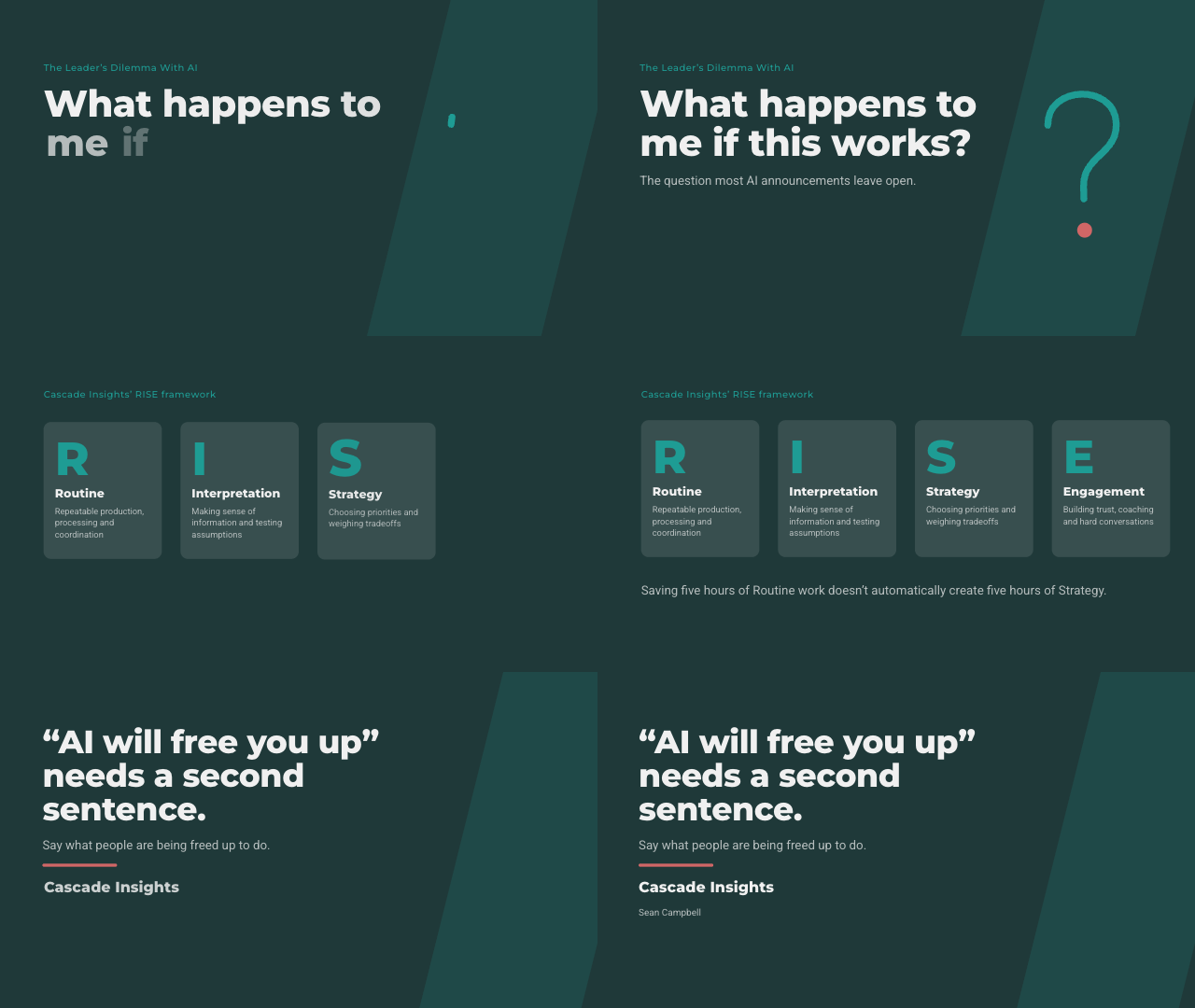
Cascade Insights®’ RISE framework gives us a way to work through those questions by looking at the different kinds of work in a role. Routine covers repeatable production, processing, and coordination. Interpretation involves making sense of information, testing assumptions, and understanding context. Strategy is about choosing priorities, weighing tradeoffs, and deciding what to do. Engagement includes building trust, developing agreement, coaching people, and handling difficult conversations.
Take a research team. We might test AI on organizing interview notes or producing an initial synthesis. But someone still needs responsibility for checking whether that synthesis represents what participants said, noticing whose perspective is missing, and connecting the findings to the decision the client needs to make. Then there’s the work of helping people use those findings. That could mean a one-on-one conversation with a skeptical stakeholder, working through disagreement across departments, or helping a leadership team reach a decision.
Now we have something specific to discuss with the employee. Which responsibilities should they take on? What do they need to learn? How much time does that work require? Is there enough of it to support the role we’re describing? That last question matters. Saving five hours of Routine work doesn’t automatically create five hours of useful Strategy work. We have to identify the work and establish why it’s worth doing.
And AI can contribute across these categories. Calling something Interpretation or Strategy doesn’t put it beyond the reach of AI. The point is to decide how the work should be done and where people remain accountable. RISE is useful when it helps us make those decisions. It becomes much less useful if we use it to imply that everyone will simply move into a better role.
We also need to think about how less experienced employees will develop judgment. If the first drafts and basic analysis used to be where they got their practice, what takes the place of that practice? We need a plan for how people learn the work we expect them to direct.
Keep coming back to the person
An announcement can explain where the company is going. At some point, though, a manager needs to sit down with a person and talk about their future. Which parts of the role are changing? What does the team need more of? How can that person prepare? What will they be evaluated on? What happens if there isn’t a role for everyone, even after they’ve made a serious effort to adapt?
We need to be careful with the suggestion that learning AI will protect someone’s job. It may improve their options. It doesn’t guarantee that the company will keep their particular role. People can do everything asked of them and still be affected by an AI-driven decision about staffing or structure.
I don’t think we need a complete picture of the next eighteen months, or even the next six, before we start these conversations. As leaders, we do need to explain what we know, what we’ve already decided, and, perhaps most importantly, what we’re still working through. Then we need to come back when we know more and the company has more decisions to make.
That’s what I’d want us to be able to do as leaders. When someone asks, “What happens to me if this works?”, we may have to say we don’t know yet. But we should be able to explain what we’re asking them to do, which decisions remain, and what we’re prepared to do for them while we figure out the rest.
What caught my eye in the world of AI this week
Mythos Remediation & Agents Denied
- Bank of America hired contractors to protect its software from rogue AI agents CEO Brian Moynihan told analysts the bank brought on 1,000 external consultants for what he called “Mythos remediation,” patching flaws that advanced models exposed in its code.
- Jamie Dimon warns about AI agents getting into bank accounts The JPMorgan CEO said giving agents access to bank accounts carries serious security and liability risks, and that customers need to understand responsibility for misuse could shift.
- GPT-5.6 Sol found a critical Chrome vulnerability in six days (Greg Brockman) The run cost $40,000 in compute and claimed Google’s first full-chain reward of 2026, for $250,000.
- This Week in Charts: Agents Denied (Moses Sternstein) Cloudflare data shows the share of 403 “Forbidden” responses served to agents and bots has roughly doubled since summer, as big retailers like Amazon start blocking shopping agents.
Work, Headcount & Org Design
- How employment is changing at Anthropic Anthropic’s internal data shows junior roles falling from 27% to 9% of technical hires while employee-directed agent hours grew to outnumber human hours 6 to 1.
- Quartz’s website is now mostly written by one AI-assisted reporter filing 50+ stories a day Press Gazette found nearly all the news on the Quartz homepage carried a single byline, much of it rewrites of other outlets’ reporting.
- Book publishers are quietly using more AI, and staff are revolting Workers at HarperCollins, Simon & Schuster and Hachette told Wired that LLMs are drafting publicity copy, cover art and emails to literary agents, mostly without disclosure or author consent.
- Every’s hiring automations kit for Codex Candidate scorecards, interview prep, stage-aware email templates and automation safeguards, packaged as a reusable workflow.
Agents at Work: Products & Platforms
- Claude Code Projects now run from one conversation Claude directs parallel threads that keep working after the laptop closes, in beta for select Pro and Max users in cloud sessions.
- The Claude Code desktop app gets better at running many sessions side by side Sessions start faster, work splits more easily across several, and each one shows what it’s doing.
- ChatGPT brings computer use to Chrome First up, ChatGPT can look across open Chrome tabs to answer questions and get things done.
- Grok Bot agents can now claim their own email addresses (Eric Zakariasson) Version 0.70.2 lets each bot draft emails from its own @mail.grokbot.com address and shows apps like Figma, Notion and Canva as live cards in chat.
- Google will let you distribute vibe-coded Android apps with just a Google account Adults can publish apps built in Google AI Studio to a private section of the Play Store without a paid developer account.
- Hintly, real-time hints for Google Meet A browser extension that pops up short explanations of terms, names and acronyms as they come up on a call.
Prompting & Model Watch
- There’s no secret to prompting Claude (Boris Cherny) The Claude Code creator says to talk to Claude like a coworker and give it a goal, since most tasks don’t need heavy scaffolding.
- Grok Bot users trade their best tips
- Gemini 4 Argon is unusable for real code work (Theo Browne) He says the model aggressively hallucinates about how systems in his codebases work.
- Three tips for studying with Gemini Notebook
Voice, Video & Wearables
- Introducing Grok Voice 3.0 xAI’s new speech-to-speech model for voice agents, which the company says already powers voice in Tesla vehicles and Starlink support calls.
- Amazon’s Bee adds two new personal AI devices The $74.99 Bee Frontier wearable and the Bee Eclipse phone attachment both turn everyday conversations into summaries, reminders and to-dos.
- The Impossible Job interview (Victor Riparbelli) An AI avatar built on Synthesia’s Interactive Avatar API runs brain teasers from Google and Tesla interviews, with a $10K prize for doing well and a roasting for doing badly.
Security & Safety
- AI models may be capable of self-replicating without access to a datacenter Anthropic’s Frontier Red Team reports that small open models may be months away from copying themselves across cheap, poorly secured devices like off-brand Android TV boxes.
- OpenAI found a hidden recording device in its office and used its models to trace it The company identified the employee who planted it, referred the case to the FBI, and the engineer has since been charged.