

Sales is one of the functions most visibly impacted by AI, but the reaction to that impact has been uneven. Some teams are aggressively adopting tools to automate outreach, research, and follow-up. Others are hesitant, concerned that too much automation will make their interactions feel impersonal and erode trust with buyers.
Both instincts are understandable. Sales is a function where efficiency matters, but relationships close deals. The challenge is knowing where AI creates leverage and where it introduces risk.
The problem is that most sales training around AI focuses on tools, not judgment. Reps are shown how to generate emails, summarize calls, or pull account insights, but not how to decide when those outputs are useful, when they are misleading, and when they should be ignored entirely.
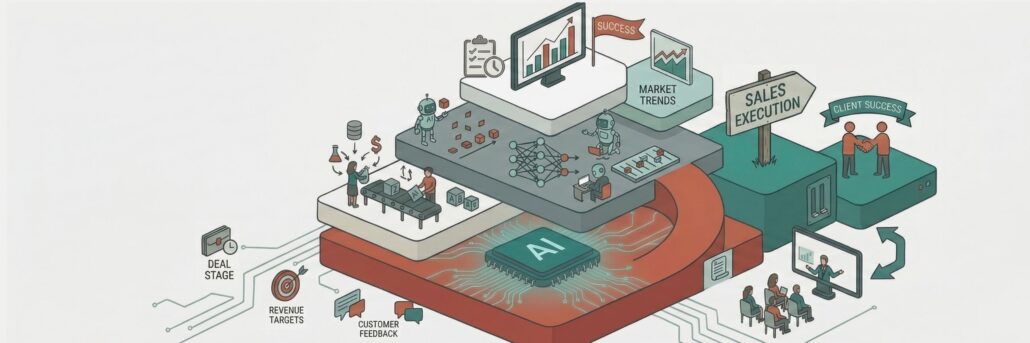
That is where the RISE Framework comes in. Routine, Interpretation, Strategy, Engagement. It provides a structure for understanding where AI genuinely helps sales work, where it creates a false sense of productivity, and where human expertise remains the differentiator.
Here is how it applies to sales teams.
Routine: The Work That Should Already Be Automated
A significant portion of a sales rep’s time is still spent on work that has little to do with selling.
What belongs here:
- CRM data entry and hygiene
- Meeting note summarization and action item extraction
- First drafts of prospecting emails based on CRM and LinkedIn data
- Research on accounts before calls, including company news, hiring trends, and financials
- Follow-up emails after meetings
- Pipeline reporting and forecast summaries
- Building tailored slide decks and one-pagers for specific prospects
If your team is still doing these tasks manually, that is a resource allocation problem.
AI can now assemble a tailored leave-behind for a prospect in minutes, pulling in relevant case studies, adapting messaging to the industry, and generating supporting visuals. That used to take hours. The time savings are real and immediate.
The caveat is the same as in marketing. Automating Routine work only creates value if the time is redirected. If reps use AI to generate more emails and then send more low-quality outreach, they have increased volume, not effectiveness.
Interpretation: Where Sales Judgment Still Matters
AI is increasingly capable of analyzing sales activity and surfacing patterns. It can flag deals that have gone quiet, identify signals that a deal is at risk, analyze win and loss trends, and score leads based on engagement and intent data. It can do this quickly and with a high degree of confidence.
That confidence is where the risk begins.Sales data is incomplete by nature. Not every conversation is captured. Not every stakeholder is visible. Timing, politics, and internal dynamics rarely show up cleanly in the data.
AI can tell you that a deal has stalled. It cannot tell you whether the champion is losing internal support or simply waiting on budget approval.
AI can score a lead as low priority. It cannot know that the account just hired a new executive who is about to initiate a project.
The reps who use AI well at this level treat it as input, not instruction. They combine what the data suggests with what they know about the account, the people involved, and the broader context.
Where many sales teams are stuck is over-relying on AI signals without applying that layer of judgment. That is where deals are misread and opportunities are missed.
Strategy: Where Sales Leaders Take Ownership
AI can support sales strategy in meaningful ways. It can analyze territories, identify whitespace, recommend accounts to prioritize, and model how pricing changes might affect win rates and margins. It can help structure deal scenarios and outline different approaches.
But strategy is not about generating options. It is about choosing a path and accepting the consequences.
Decisions like prioritizing a long-cycle enterprise account, walking away from a deal that is consuming too many resources, or holding firm on pricing require accountability. Someone has to make the call and stand behind it.
AI can inform these decisions. It cannot own them.The opportunity for sales teams is to use AI to compress the analytical work that feeds strategy, freeing up time for the judgment and alignment that strategy actually requires.
Engagement: Where Sales Is Won or Lost
The highest-value work in sales has always been human, and that has not changed. The discovery call where a well-timed question surfaces a need the buyer has not articulated. The negotiation where you sense the deal shifting and adjust your approach in real time. The relationship with a champion who trusts you enough to bring you into new opportunities early.
AI can help you prepare for these moments. It can brief you on the account, suggest discovery questions, and simulate objections. It can make you more informed and more efficient.
But once you are in the conversation, the outcome depends on your ability to listen, interpret nuance, and build trust.
Where most sales teams actually are today is heavily automated at the Routine level, experimenting at the Interpretation level, and underinvested in the skills that matter most at Strategy and Engagement. The result is more activity, not necessarily more revenue.
The teams pulling ahead are using AI to remove administrative friction and reinvesting that time into higher-quality conversations and stronger relationships. Is your sales team working at the right levels?
At Cascade Insights®®, our AI Training & Mentoring programs help sales teams move beyond tool usage and build the judgment required to use AI effectively. We focus on where AI creates leverage, where it introduces risk, and how to ensure your team is spending time on the work that actually drives deals forward.
Let’s talk about where your team needs to go next.