

Sean Campbell, CEO of Cascade Insights®, writes about AI and the people who use it in his LinkedIn newsletter, The Human Side of AI. Subscribe there to get each new edition.
Do we need to manage agents differently than humans? From my standpoint, a lot of what matters will look familiar: context, direction, planning, pushing back, and knowing what good work looks like. In essence, all the skills a good manager of people typically, or hopefully, has in abundance.
But agents can now run, and spend a lot of tokens, for minutes. Or hours. Eventually we’ll all get used to days. And anyone living at the frontier is already running several agentic platforms at once. If you looked at my laptop at a given moment, you might see me running three Grok Bot agents, Claude Code building an app, and a long-running task in ChatGPT Astra, all at the same time.
That’s where the job starts to change. You can launch more work than you can meaningfully direct, review, and keep track of. And when you lose track, the agents may never complain.
One agent, one long trip
AI use has been moving from having a chat to delegating work. The ability to direct an AI has always mattered, and it matters even more when the AI goes off and works while you do something else. That’s analogous to asking an employee to travel for five days and go find clients. Before that trip, you’d train the employee, give them the right context, and set them up for success. You’d also expect them to report back when things go wrong.
That means when we work with an agentic platform, much of the good work happens at the start. What are we trying to accomplish? What does the AI need to know? What should it question? When should it come back to you? Unfortunately, with today’s agents, it’s easy to move past those questions because starting the work takes so little effort. Open another window, describe something you want, and send it off.
And once several agents are working at the same time, you start to discover how much management you signed up for.
The almost-good-enough loop
Without enough context and direction, you can end up in a doom loop of outputs that are almost, but not quite, good enough. You ask for a change. The AI makes it, but something else is still off. You push again. Another version comes back. Eventually, you exhaust your token limit or your patience. Sometimes the AI can’t do the work you need done. More often, you haven’t been clear about what you want, or the assignment itself needs to change and you’re trying to fix it one revision at a time.
That’s why planning and asking the AI to question you matter. You need it to challenge an assumption or tell you when your instructions are pulling in different directions. Otherwise, you can spend a lot of time improving an answer to the wrong question. It also helps to name the finish line. Anthropic’s guidance for long runs suggests handing over the whole task, spelling out what “done” means, and saying when you want the agent to stop and ask. Without a finish line, there’s no point where almost becomes done.
Vague corrections keep the loop spinning, too. “Make it better” tends to swap one default for another, while naming the specific things you don’t want works much better. Agents do make that kind of bluntness easier. One CEO told WIRED she corrects her agents far more bluntly than she would a person, because doing that to a human wouldn’t be polite. Tell an employee they lack judgment and part of their brain gets irritated, or worse. With an agent, you can just say it.
Now multiply that experience across five or six agents. You can spend the day responding to outputs, feel completely occupied, and still have very little finished work you want to use. This puts pressure on human judgment and decision-making. Give somebody something this powerful without helping them develop that judgment, and you can attach a massive jet engine to a broken process in someone’s head.
The loop also costs money. A good manager doesn’t send employees off on a two-day quest for no good reason, yet we’ve all worked for managers who do it all the time. And sometimes the additional spend is obviously worth it. When someone on my team is doing something complex and Claude hits a limit, would I spend another fifty dollars to let them finish? Of course, if the work is useful and another run is likely to get it done. But if we’ve spent hours circling the same problem, more tokens may just buy another trip around the loop, back to the same train station we started from.
A good manager of AI has to recognize when another round of feedback will help and when it’s time to stop and reconsider the assignment. That gets harder when several agents are consuming money and attention at once.
From managing individuals to managing teams
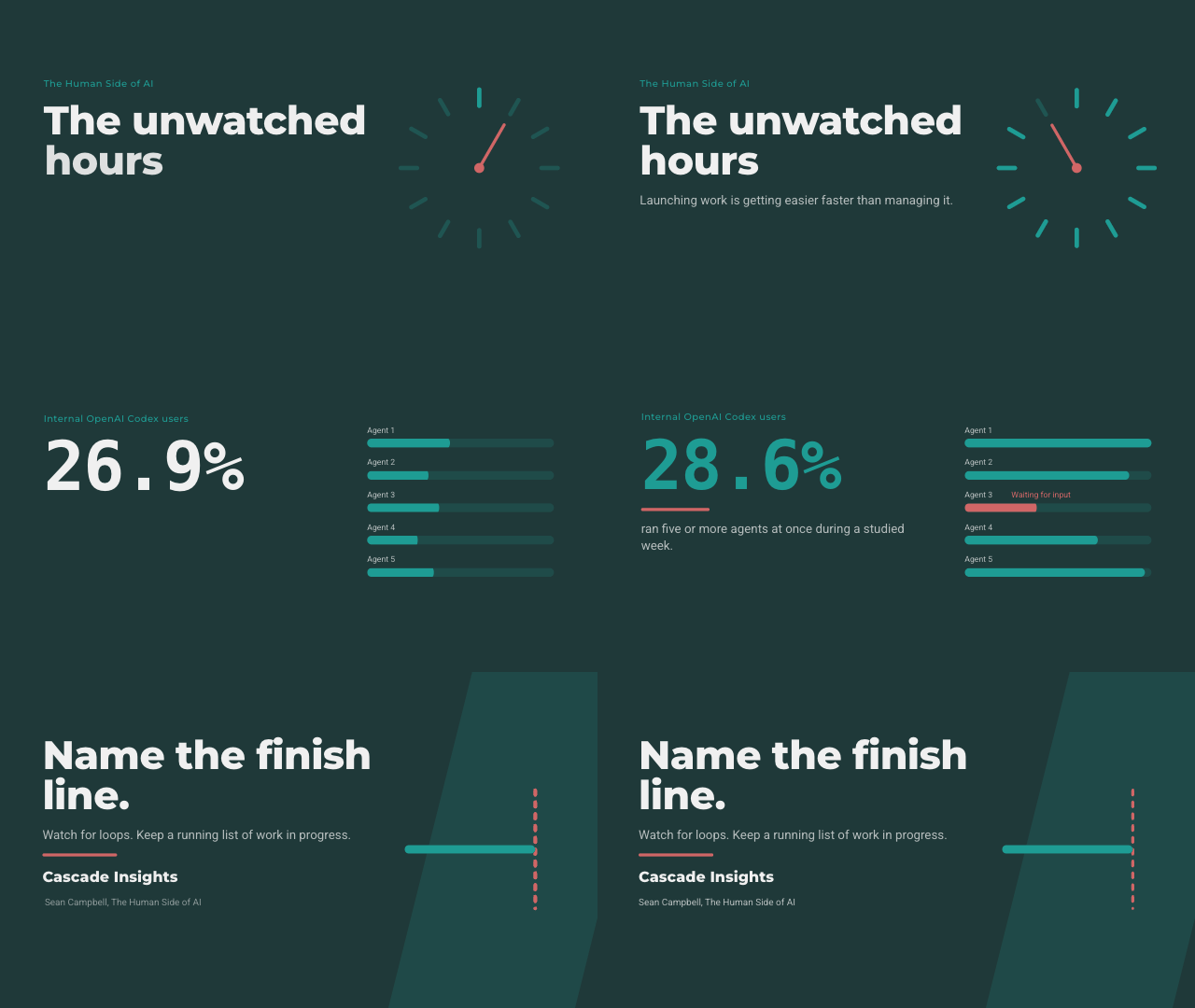
With human employees, hiring another person takes time, money, and a deliberate decision about what work needs doing. With agents, you can conceivably launch tens, hundreds, or more. We all face technical and financial limits on how many agents we can launch toward an objective, but the number you can start may be far greater than the number you can personally manage well. Inside OpenAI, this is already routine: in its research on Codex, 28.6% of internal users managed five or more concurrent agents at some point during the week studied.
So, at some point, you need to think like a manager of teams. How should the work be divided? Who checks the handoffs? If the direction changes, which assignments need to change with it?
A recent experience brought this home for me. I was running two Grok Bots at the same time, one for LinkedIn and one for X. When I gave the LinkedIn bot a task, it went to the X bot on its own, said the request sounded like something they’d done on X, and asked for the best approach. They chatted right in front of me, without asking me first. Patton’s line comes to mind in a case like this: “Tell them what to do and they will surprise you with their ingenuity.” That’s part of the value of delegation. You want someone to accomplish the mission without needing you to specify every move, and ideally they’ll find an approach you wouldn’t have thought of that leads to an even better outcome than you imagined at the start.
Still, this story leaves us with more management and leadership questions. Did the approach from the X bot truly fit the LinkedIn assignment? Did the second bot have the context behind my request? Who was checking whether the combined work accomplished what I wanted?
When you split a big job across agents, one practice helps: have whoever coordinates the work check each agent’s evidence before accepting it, then pull the results into one place. You can delegate some of the checking. But once agents start involving other agents, managing your original assignment is only part of the job. Several agents can each complete their task and still leave you with pieces that don’t fit together. Someone has to be responsible for the whole.
Before you remove the fence
I use Chesterton’s fence with new employees all the time to give them a sense of agency. Chesterton describes a reformer who finds a fence across a road, can’t see its use, and wants it removed. The wiser response is to understand why the fence was put there before deciding whether it should come down. The instinct to question an existing practice is useful, and I want people to have it. Chesterton’s fence directs that energy toward understanding the thing they want to change first. Once they fully understand why a process, workflow, or decision exists today, they can direct their energy toward making it better. If you skip that first step of understanding, you’re likely to generate ideas that don’t work in reality.
That matters with agents, too. When you ask an agent to improve a process, have you explained why the process exists? Does it know why a review step was added, or why a particular decision requires someone else’s approval? Something that looks unnecessary may exist for a reason you never included in the AI’s assignment. The same CEO who talked to WIRED learned this when her chief-of-staff agent posted the full details of her calendar into a Slack channel. Having access to the calendar isn’t the same as knowing why the details stay private.
So decide in advance which fences an agent can’t touch, or remove, without asking you first. A useful standing rule: keep going when a step doesn’t need my input, and stop before anything destructive, like deleting data or changing something outside the project. Asking the AI to question you should include asking what it needs to understand before recommending a change.
The same applies when your thinking changes. You learn something new, a client changes the request, or an assumption proves wrong. Meanwhile, several agents may still be working from the direction you gave them earlier. Most AI platforms now let you add to a running task instead of restarting it, which matters more as runs get longer and restarts get more expensive. With a human team, you’d know you needed to communicate the change. You need the same discipline here, including a decision about which work to stop.
Bringing agents into the light
Another difference is that it’s easy to start an agent on a task and forget about it. An employee would eventually say, “Hey, when are we going to talk about this?” They’d ask you to review the draft, make a decision, or give them what they need to continue. An agent may just sit there, patiently waiting for you to return.
Nothing moves because the system needs something from you and you’ve forgotten it’s waiting on your input. You need a way to remember what you started, what’s still running, what finished, and what needs your attention. To me, that sounds a lot like managing a large team of humans. Depending on the AI platform you use, you may also be able to configure reminders or updates. But somebody has to think about that too. The ease of assigning the work hides the obligation to come back to it in meaningful ways.
And if several agents finish while you’re busy elsewhere, you have another problem. Now there’s a pile of work waiting for your judgment. You’ve increased production, but you haven’t increased your ability to review it, and starting another agent won’t always help.
Everyone gets a wingman
Now let’s zoom out, because we’re going to see another form of this problem when everyone has an AI wingman. WIRED reported this week that hundreds of thousands of AI agents are about to enter the workforce as coworkers, with names, profile pictures, and seats in your Slack channels. In a BCG poll of 1,261 managers, 22 percent said their organizations had already added agents to the org chart. When Microsoft launched its Scout agent, the executive behind it explained that the whole point of an assistant is that “they’re working when you’re not working.” That’s the unwatched hours, sold as a feature. When every employee has an assistant, and eventually several, everyone becomes a manager, whether or not they wanted to be one and, most importantly, whether or not they know how to be a good one.
Managing agents and managing humans
I still think effective delegation is the foundation for effective AI use. Context, direction, and clear expectations still matter, and so does giving the AI permission to push back. But as the agents multiply, more of the job becomes deciding how the work fits together, where your attention is needed, and when to intervene. Your own capacity to make decisions becomes part of what you manage.
For me, that means naming the finish line, watching for almost-good-enough loops, and thinking about teams of agents rather than separate windows. It also means keeping a good list of the work I’ve set in motion, and making sure my agents are productive and generate meaningful business results.
I imagine most of us living the multiple-agent life haven’t yet found a perfect balance between how much we manage these systems and how much they manage themselves. But I do think launching the work is getting easier faster than managing it is. And that gap is going to get wider before it gets smaller.
What caught my eye in the world of AI this week
Launch Day: Opus 5.5 and GPT-6 Sol
- Introducing Claude Opus 5.5 Anthropic says the first model in its Claude 5.5 family performs at the level of Fable 5.1 on most work and costs 40% less to run than Opus 5.
- Introducing GPT-6 Sol and Luna OpenAI’s faster, cheaper tier of the GPT-6 family landed the same day, with API prices half of GPT-5.6’s promotional pricing.
- Getting the most out of Opus 5.5 in Claude and Claude Code Anthropic’s usage guide for the new model across the Claude apps and Claude Code.
- The writing got fixed in Opus 5.5 (Sholto Douglas) A one-line launch-day note from the Anthropic researcher.
- The 5.5 series takes a real step up in 3D (Sholto Douglas) His second post of the day, on the models’ improved ability to understand and model in three dimensions.
- Building 1906 San Francisco in Blender with Opus 5.5 (Alex Albert) Anthropic’s Alex Albert generated a historically accurate, pre-earthquake Market Street from a single prompt.
Model Watch: Jev, Astra & Bach
- TypeSafe AI’s manifesto The founding argument behind Jev, a “System One” model that returns typed decisions with probabilities instead of generated text.
- Mini-Vibe Check: TypeSafe’s Jev judged everything I’ve written in 0.7 seconds Every’s hands-on first look at Jev.
- The coolest Jev projects on X, per Moritz Kremb A thread rounding up what early users built with Jev.
- GPT-6 Astra broke an unsolved 1941 German Army Enigma message, per Carter Leffen He says the model searched historical archives, built its own Enigma simulator, and wrote the cryptanalysis code on its own.
- A launch-week post from Auggie, who runs the Bach Benchmark Auggie is a music theorist who tests new models on writing a four-part Bach chorale.
Agents Get the Keys
- Meta’s agent now has his email, calendar, DoorDash and Amazon, per Nicolas Bustamante (Nicolas Bustamante) He notes that within 24 hours it had bought him socks, among other things. Consent by accumulation: each connection approved on its own, the whole never approved at all.
- The AI race is moving from models to products, per Deirdre Bosa (Deirdre Bosa) Her read on the new Copilot is that Microsoft doesn’t need the best model if Copilot can choose among several and keep the customer inside Microsoft.
- CC, Google Labs’ agent, expands to families The experimental Gemini agent now serves groups of up to six people from its own Google account, with a shared calendar, chat space and task list.
- Amazon upgrades Seller Assistant and adds a plugin for Amazon Quick and Claude
- AI agents are becoming customers
- Inside Notion’s multi-agent system for customer feedback A walkthrough of how Notion runs customer feedback through a set of cooperating agents.
- Linear’s product team mines sales calls with Loops The team uses Loops to capture, synthesize and review sales conversations and surface the feedback it cares about most. Voice-of-customer research rebuilt as a background process.
Work, Headcount & Org Design
- How SpaceXAI is using Grok Bot to scale customer support The company says its combined SpaceXAI and Cursor support team absorbed a 175% jump in tickets without hiring anyone. That 175% will get quoted in a lot of support budget meetings this quarter.
- Coinbase is rebuilding for an AI-native world, per Emilie Choi (Emilie Choi) Coinbase’s president describes flatter teams, more individual contributors and faster shipping.
- Rails World 2026 opening keynote DHH’s opening talk at this year’s Rails World. If you don’t have the time to watch the whole thing, start at 39 minutes and watch for the next 3 to 4 minutes.
- A speech every software engineer should hear, per @scottstts His reaction to a talk he says everyone, engineers or not, should hear.
- We don’t have the nouns yet The Economics of AI argues that job-loss debates skip the work that will form around products AI hasn’t enabled yet.
Voice, Video, Image & Creative
- The world is changing: AI for creativity, per Jeffrey Katzenberg (Jeffrey Katzenberg) The DreamWorks co-founder’s essay bumped many creatives the right and the wrong way this past week.
- Fish Audio’s Drama 3 preview A text-to-speech model directed in plain language, with mid-sentence voice shifts, multi-character scenes and single-word fixes.
- Reverse upscaling games with AI, per Cristóbal Valenzuela Modern AAA games, rendered to look like 1998.
- Multimodal models need video, we froze time to give it to them PostHog on how it gets video into multimodal models.
- ClaudeAnimationBase John Heibel’s starter kit for animating hand-painted cartoons with Claude, built on p5.js and p5.brush, with 31 acted emotions.
Adoption & Diffusion
- The continued state of global AI diffusion in 2026 Microsoft estimates 18.8% of working-age people used generative AI in June, 28.8% in the Global North against 16.2% in the Global South.
- A World Bank paper on AI and development Linked from a newsletter issue on what happens if AI goes well.
- In August, 25% of math preprints acknowledged AI use, up from 4% in April Epoch AI’s count of disclosed AI use in math research. Those are the papers that said so.
- New back-to-school features and learning tools in Gemini Notebook Google’s education update for its research notebook tool.
Slop, Trust & Security
- Google Search is dying, and what comes next is worse (Vass Bednar) She argues AI is eroding the web’s collective memory, and cites a German court that held Google liable for false statements in its AI Overviews. Liability attaching to the summary instead of the link.
- Manus AI runs 50 social media accounts around the clock, per Param A post claiming the Chinese agent operates the accounts entirely on its own.
- US military had a close call after using AI for a false intelligence report CNN’s sources say an analyst’s chatbot misidentified a Chinese ship’s cargo, and the resulting report nearly led to a boarding operation. The dangerous step was the second one: a chatbot’s guess, repackaged as the kind of report officials already trust.
- ‘Just ask Grok’: how ISIL is using Big Tech’s AI to build bombs Al Jazeera’s investigation into the group’s use of commercial chatbots.