
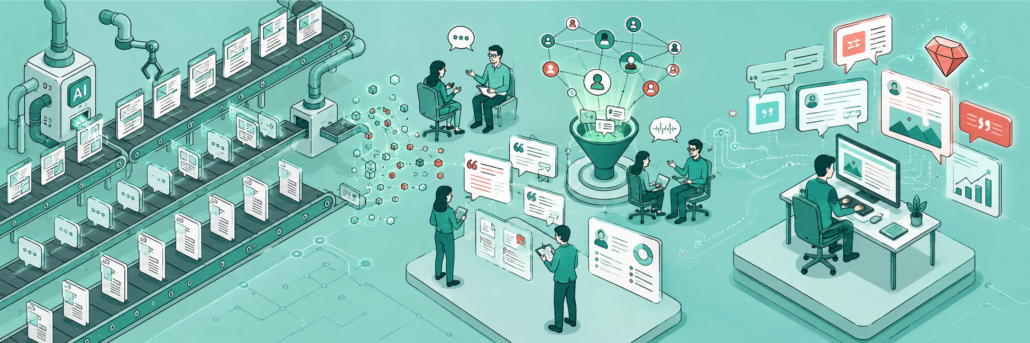

Search for almost any marketing topic today and you’ll find seven near-identical guides using the exact same metaphors. As Forbes Technology Council recently noted, that’s because AI models are trained on the internet’s vast supply of average copy, so generic prompts just recycle the noise.
Marketers feel this fatigue every day. We’re drowning in AI slop: generic value propositions, landing pages built from the exact same six headings, and case studies that feel manufactured instead of written. It all technically works, but it also compounds. After a year or two of writing this way, and the sameness gets baked in deep enough that unwinding it gets hard. What actually works is starting with a real idea, then letting AI help build it out, not the other way around.
To get content that actually sounds like your brand, you have to stop dipping your bucket into the same collective well as everyone else. You need a unique idea, and proprietary insight is one of the most reliable ways to find one. By using direct market research like buyer interviews and win-loss conversations, you tap into real buyer language that hasn’t been scraped into an AI training set.
The AI Content Sameness Problem
It’s easy to blame bad writing, but the data says otherwise. Ahrefs found that 86% of top-ranking content uses AI, with zero correlation between AI percentage and rankings. Google isn’t sorting by authorship. The real breakdown happens one step earlier: at ideation.
According to an Ahrefs survey of nearly 900 marketers, over 70% use AI for brainstorming and outlining, far more than for final writing. When an entire industry asks the same model for direction, everyone gets handed the same roadmap. Nobody plagiarized anyone; everybody just started from the exact same baseline.
Even using AI “just for structure” doesn’t save you; if anything, it’s the riskier move. A CHI 2025 study found that found that AI-guided thinking caused a lasting drop in idea diversity that outlasted the AI itself, while getting direct answers from AI didn’t. The damage isn’t necessarily from using AI, but rather from letting AI shape your thinking before you’ve formed a point of view of your own.
The same pattern holds at scale. A study analyzing 2,200 college essays found that human writers continuously generated new concepts, while GPT-4 quickly hit a wall of repetition. Individual output gets better. Collective variety collapses. That’s the real mechanism behind the sameness.
Voice of the Buyer: The Missing Input
Forbes’ piece takes this one layer deeper, and it’s the layer that matters most for B2B. AI language models learn to write marketing copy from the full archive of marketing copy that already exists, including a staggering amount of it that was forgettable. Feed a generic prompt, built from category language and standard positioning, and you get back a fluent, coherent version of what “everybody” already sounds like. That’s not the model failing. It’s the model doing exactly what it was trained to do with the input it was given.
There’s one category of language it has never trained on: what your actual buyers say, unscripted, in their own words, before anyone coached them into your category’s vocabulary. Here’s what that actually sounds like:
- The phrase a prospect uses to describe a problem they’ve had for two years.
- The specific way a churned customer explains what changed the day your product stopped working for them.
- The word an internal champion reaches for to sell the deal to their own VP.
None of it exists anywhere on the public internet. It exists in a conversation, and only if someone has that conversation and captures it properly.
Spoken language does something written survey responses can’t. A survey answer is shaped by the question and edited before it’s typed. A conversation lets someone backtrack, reach for an unexpected metaphor, and land somewhere they wouldn’t have written down. That’s where the specific, emotionally accurate material lives. It’s the raw material a content brief actually needs, not a research finding to file away afterward.
Generic AI Content and Search Visibility
Bland content doesn’t just damage your brand identity. It also hurts your discoverability.
Google’s Information Gain algorithm was explicitly designed to penalize pages that repeat existing search results. If your content doesn’t add new insight to what’s already ranking, Google’s systems can demote or ignore it, no matter how polished the writing is.
The stakes are even higher in AI Search:
- First-Party Data Wins: Original, first-party data earns 3.3 more AI citations than rehashed content, making it the single strongest predictor of whether a page is seen as genuinely novel.
- The Citation Cutoff: When an AI answer engine runs multiple background searches for a user, it has zero reason to cite the fourth source saying the exact same thing as the first three.
Whether sameness happens at the idea level or the language level, the penalty is identical: if you say what everyone else says, you get skipped.
Buyer Voice as Content Strategy
Here’s where we take the argument a step further: market research isn’t just something to file away in a slide deck. It is your direct pipeline to the single rarest commodity in B2B marketing nowadays: unscripted buyer language that no AI model has ever scraped.
When we sit down with your buyers, churned accounts, and lost prospects, we aren’t just asking generic survey questions. We capture how they actually describe their problems in their own words, including the parts that surprise you.
This unscripted insight:
- Transforms your briefs: Takes your content from recycled category jargon to insights only you could publish.
- Satisfies the algorithms: Feeds Google’s Information Gain models and AI search engines the novel, first-party data they demand.
- Converts the reader: Makes a prospect stop scrolling and think, “That’s exactly what I’m dealing with,” instead of tuning out another generic pitch.
As we’ve said before about AI-assisted market research: AI is fantastic for analyzing, structuring, and accelerating research. It is not a substitute for the conversation itself. You simply cannot prompt your way to language your buyers haven’t said yet.
The Fix for Generic AI Content
As the old adage goes, “You can’t get fresh water from a shared tap.”
AI didn’t create the sameness problem on its own, and clever prompt engineering won’t fix it. The real fix sits entirely upstream.
When you feed an AI tool the same category tropes every competitor uses, you get the exact average of your industry back. Polishing a generic output doesn’t change the quality of the water in the bucket.
A Quick Exercise Before Your Next Campaign: Audit your top three landing pages alongside those of your three closest competitors. Now, swap the logos. If your value proposition, headings, and copy still make total sense on a competitor’s site, your content is drawing from the public well.
To stand out to buyers (and search engines) you have to go upstream. Stop guessing what your market cares about and start capturing their unscripted words.
Ready to stop recycling category language? Let Cascade Insights® conduct the B2B market research you need to extract unscripted buyer voice, power your content strategy, and build a brand no AI can replicate.
At Cascade Insights®, we specialize in B2B market research that surfaces the language your buyers actually use, so the content and messaging built from it sounds like your market instead of like every other AI-assisted competitor in it.