
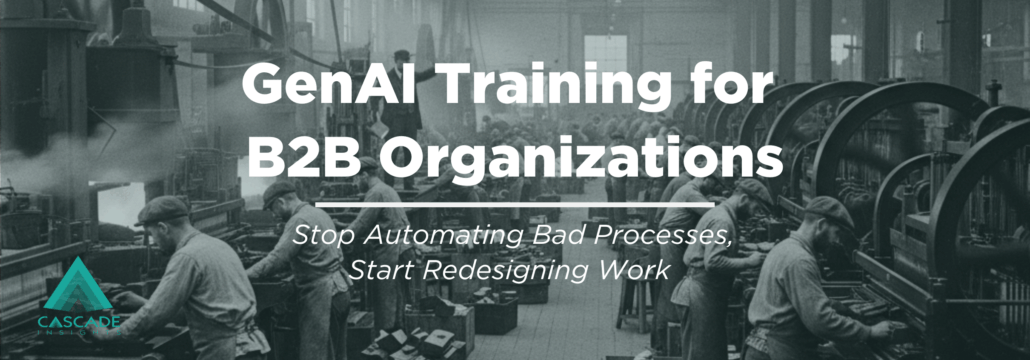

When factories first got electricity in the 1890s, productivity barely changed. Manufacturers had replaced their central steam engines with electric motors, but kept the same belt-driven layouts. They’d adopted the technology without understanding it.
It took 30 years for someone to ask the right question: What if electricity’s real value isn’t replacing steam engines, but decentralizing power? Once factories redesigned around individual electric motors for each machine, productivity exploded by 50%.
Today, B2B organizations are making the same mistake with GenAI. They are approaching GenAI training as if it were another productivity tool rollout, no different from training sellers on Salesforce or onboarding marketing teams to a new automation platform. Employees sit through generic training and then return to their desks and nothing fundamentally changes.
That’s the old electric steam engine approach: update the machinery but not the mindset. And it’s stifling the full potential of GenAI.
Why the Software Rollout Approach Fails in GenAI Training for B2B Organizations
By limiting GenAI to merely another tech tool rollout, you automate the inefficient steam-powered factory floor instead of redesigning workflows entirely. When this happens, the damage compounds quickly.
Productivity decreases as employees juggle new tools alongside old workflows. Shadow AI spreads as teams adopt unapproved solutions inconsistently, creating security and compliance risks. Training investments yield no measurable returns. Competitors who integrate AI strategically begin to pull ahead. Leadership’s patience wears thin. What started as transformation becomes another sunk cost.
The problem isn’t the technology. It’s the enablement strategy. Those 1890s manufacturers didn’t have a steam engine problem or an electricity problem. They had an imagination problem. They couldn’t see past their existing factory layouts to envision what electricity made possible.
Your organization faces the same challenge. Thriving in this era requires more than learning new tools. It demands a deliberate, organization-wide effort that starts with first raising awareness of what GenAI can do today, not what it did yesterday. Then, teams must be grounded in the most current capabilities and use cases.
From there, organizations must reskill employees, identify pilot projects and internal champions, and redesign workflows to integrate GenAI meaningfully into everyday operations. Only then can GenAI move from experimentation to organization-wide enablement.
GenAI Training for B2B Organizations: 5 Steps to Transforming Business Operations
Successful GenAI training for B2B organizations begins with a completely different mindset that treats GenAI enablement as a fundamental redesign of business operations, not an IT driven implementation. Here are five steps to move you from mere awareness of GenAI’s potential to deep organizational change that benefits employees, the organization as a whole, and your end customers.
1. Executive Sponsorship and Strategic Framing
GenAI enablement must be a business imperative, sponsored by business leaders in every business unit who can articulate:
- Why GenAI matters for competitive advantage in their given area of the business.
- What their organization will look like in 1 month, 3 months, 6 months and a year as GenAI tools and workflows are adopted.
- How GenAI enhances (not replaces) human expertise
- What’s at stake for their department if the organization doesn’t adapt quickly enough.
Think back to those factories. The breakthrough didn’t come from better electricians. It came from business leaders who asked: “If we could place power anywhere, how would we design this factory and what outcomes would that lead to?” That question unlocked the transformation.
Your organization needs leaders willing to ask: “If AI could handle this task in seconds, how would we redesign this entire process?”
2. Workflow Mapping and Use Case Identification
Before any training, you must understand how each department works today. Where are the biggest inefficiencies? What repetitive tasks drain time? Which workflows create bottlenecks?
Effective mapping goes deeper than surface-level process documentation. It requires understanding:
- Real-world decision-making processes, not just what org charts say should happen
- Where workflows actually break down in marketing, sales, and customer success
- The jobs-to-be-done for different roles across B2B departments
- How insights flow (or fail to flow) across departmental boundaries
The factory owners who succeeded with electricity didn’t start by buying motors. They mapped their production workflows first. They identified where centralized power created bottlenecks. They spotted which processes would benefit most from independent power sources. Then they redesigned deliberately.
Without this insight, your training will always miss the mark. Generic sessions fail because they’re not connected to the actual tools, processes, and pain points that define how your teams operate.
3. Role-Specific, Workflow-Based Training
Training must be grounded in real work, not theory. That means developing department-specific, role-specific programs that reflect how people actually do their jobs.
Each session should:
- Workshop live examples using real projects, documents, and datasets from the team’s current workload
- Redesign real deliverables by reworking existing reports, proposals, or campaigns with AI tools to show tangible improvement
- Demonstrate near-term impact focused on how AI can streamline next week’s tasks, not hypothetical “someday” use cases
When training connects directly to each role’s daily reality, employees immediately see GenAI’s relevance to their work. This accelerates adoption, builds confidence, and ensures GenAI becomes embedded in the workflow rather than existing as a standalone tool people forget after the session ends.
This is an approach that blends mentoring, team specific training, and organization wide awareness of what’s possible with GenAI today and tomorrow. Rather than one central “AI training program” that serves everyone poorly, you create targeted capability-building that meets each team where they work. Just as individual motors transformed each workstation, role-specific training transforms each function.
4. Extended Mentorship for Long-Term GenAI Enablement
Enablement doesn’t happen in a single workshop. It requires:
- AI champions in each department to guide peers in real time
- Regular office hours for hands-on problem-solving
- Feedback loops that evolve workflows as teams learn
- Celebration and storytelling to build momentum and normalize success
Those factories didn’t flip a switch and suddenly operate at 50% higher productivity. They evolved over years. Workers discovered new capabilities. Engineers refined processes. The organization learned together.
5. Ongoing Optimization and Leadership Engagement
Even after the first wave of GenAI enablement, the real work is only beginning. Early factory owners didn’t unlock productivity gains the day they wired their buildings. They achieved them through years of iteration and redesign. GenAI adoption follows the same pattern.
This isn’t a one-time rollout. GenAI is evolving too quickly for that. New tools, new approaches, model upgrades, and workflows appear every month. What was cutting-edge last quarter might already be outdated. To keep pace, leaders must treat GenAI enablement as an ongoing business capability, not a completed project.
That means regularly asking:
- How have new GenAI features changed what’s possible in our workflows?
- Which teams are experimenting, and what can we scale from their success?
- What skills need refreshing as new tools emerge?
For example, marketing teams that trained on text generation six months ago now need to learn how to combine multimodal tools for campaign ideation and content creation. Research teams that began using AI for synthesis must now adapt to tools that automate qualitative coding or generate data visualizations.
Continuous leadership engagement is essential. Without it, enablement stalls as fast as the technology evolves. The organizations that succeed are the ones that make experimentation, retraining, and iteration part of their operating rhythm, just as factory leaders once redesigned entire production lines around new sources of power.
Don’t Wait 30 Years: The Urgency of Redesigning Work with GenAI Today
“The greatest danger in times of turbulence is not the turbulence. It is to act with yesterday’s logic.”
— Peter Drucker
It took manufacturers 30 years to understand electricity’s real value. You don’t have 30 years. Your competitors are redesigning their workflows right now. The question isn’t whether GenAI will transform B2B work. The question is whether you’ll lead that transformation or watch it happen to you.
So before your next GenAI training, ask yourself:
- Do we know where GenAI can truly impact each department’s daily work?
- Are we measuring business outcomes or just training attendance?
- Are we replacing our steam engine, or are we redesigning the factory?
If you answered no to any of these, give us a call. For more than two decades, we’ve helped B2B organizations adopt and operationalize new technologies. We understand that successful GenAI enablement isn’t about generic training. It’s about aligning people, workflows, and technology to create lasting capability and meaningful competitive advantage.
Explore our AI Training & Mentoring Services and AI Change Management Services to turn GenAI ambition into measurable business transformation.