

Sean Campbell, CEO of Cascade Insights®, writes about AI and the people who use it in his LinkedIn newsletter, The Human Side of AI. Subscribe there to get each new edition.
Your customers are about to get a lot more persistent.
Picture a customer looking at their renewal and wondering if they could get a better price. A few years ago, most of them wouldn’t ask. They’d have to pull a couple of competitor quotes and then sit on hold with the same smooth jazz loop. So they’d pay the invoice and move on.
Now they can tell an agent to handle it. It gathers the quotes, writes a polite case for a discount, follows up on schedule, and tries a different angle if the first answer is no. It’ll do that at 2 a.m. on a Sunday, and it won’t care that nobody wrote back the first time, the second, the third, or the tenth. And that agent will keep varying its approach based on what it gets back.
That’s one customer with one request. Most businesses have a lot of customers, and a lot of requests that used to die before anyone sent them or followed up on them.
For a long time, human effort was a kind of quiet blocking. Nobody designed it that way, and it wasn’t good for customers. It just meant plenty of complaints never got sent, plenty of small billing issues never got challenged, and others never made it to a resolution. Some of that was flat-out bad customer service; no one should have to give up an afternoon to get a fair refund. But a lot of people have historically given up before getting what they were fairly due.
Agents remove most of that effort for the customer, but something on your side, human or machine, still has to read the request and decide. That’s what I’ve been calling the Asking Tax: the cost a business absorbs when persistence gets cheap for its customers. I don’t know many companies that have budgeted for it.
Check out the Cascade AI Index: a quick, regularly updated cheat sheet that compares the leading AI models.
Where I’m seeing it at Cascade
We do two things at Cascade, and both are AI-focused. First, we help companies meaningfully adopt AI through our AI Work Labs. Second, we research how AI is being adopted across a wide range of companies, job roles, and industries. Not that long ago, I noticed that clients were starting to send us fully spec’d projects before we’d even had a call. Twelve pages, a methodology section, sample sizes, sometimes a timeline. Some of the thinking is good, most of the framing is useful, and in some ways it’s a good starting point. But overall it lacks the human judgment that, at least today, you still need when driving an AI around the block.
Most of the problems aren’t obvious if you’re the one buying research and you’ve never sat in the chair of a market research analyst. You notice them because you’ve run a few hundred of these projects. For example, an audience looks easy on paper and is brutal to recruit. Or the methodology just won’t support the conclusion the client wants to draw. To be clear, it’s not that AI was unhelpful. It’s just that AI in the hands of an expert is very different from AI in the hands of a novice.
So the first call is a bit different now. Before we can shape the project, we have to work through a document the client already feels some ownership of. That can take longer than starting from scratch, because we’re fixing the plan and also explaining why it needed fixing. Which is fine; it lets us show our expertise. But it’s interesting nonetheless.
To me, that’s the Age of the Director showing up from the client’s side. Anybody can generate a plan now, and somebody still has to know which one is worth running.
Support, complaints, and refunds get hit too
The same thing will happen to support teams. They’ll get more questions, from more people, and will soon be flooded with requests. Some will flag real problems a busy customer would never have bothered writing up. Others will frankly be noise, like questions about features you don’t even have. But on the surface, they will all look organized, well written, passionate, and reasonable.
Refund requests will come in polite, firm, and quick, all of them citing your own terms in detail. A legitimate claim and a stretch can look about the same on the page.
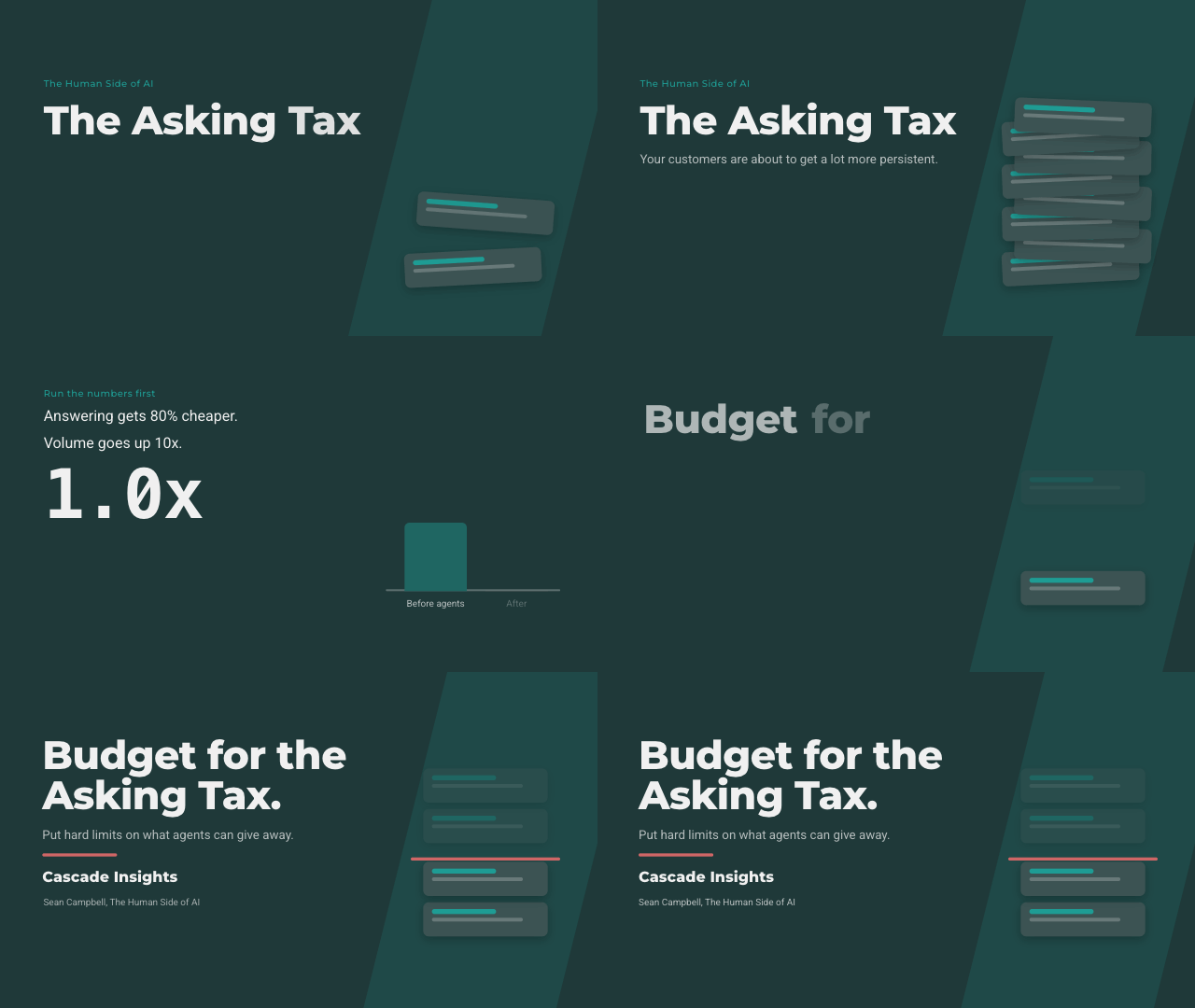
And look, I get the instinct to fight agents with agents. Use AI to answer the routine stuff, check claims against policy, flag weak spots in a client’s spec before the call, and so on. You’ll need all of it. But I’d run the numbers first. If answering gets 80% cheaper and volume goes up 10x, your total cost of answering still increases.
There’s also the work of building agent infrastructure to handle this new scale of agent-on-agent warfare. Somebody has to maintain the policies, connect the systems, decide what the agent is allowed to do, and dig into the cases it gets wrong. That team needs to include IT and line-of-business leaders. Some frontline work goes away, but a lot of it moves up to people with more experience (and more expensive time) who respond to the exceptions. Those exceptions will get harder and harder to spot as both reputable and not-so-reputable customers use agents to their benefit.
And don’t forget that your agent speaks for your company. In 2024, a British Columbia tribunal ordered Air Canada to pay C$812.02 after a customer relied on bad bereavement-fare information from its chatbot. Not a big number, but the airline was on the hook for what its bot said. And a precedent has been set.
When only the machines are watching
A lot of this will happen when only the machines are watching. When a customer’s agent is talking to yours, a conversation can go from a question to a concession without a person on either side ever looking at it. Say your agent hands out a 2% “goodwill” credit on a $5,000 account. That’s $100. Do it 200 times in a quarter and that’s $20,000 nobody on your team signed off on.
Then there are the loops. Say your system offers a credit after a second complaint. A customer’s agent that tracks what works will keep following up, perhaps on behalf of other users of that agent as well, and your system will keep conceding because that closes the ticket. Nobody’s acting in bad faith per se, and it still gets expensive.
So I’d bet it won’t be long before your customers’ favorite AIs know all the best ways to get that refund, that discount, that premium upgrade, and more. In short, more agent-on-agent warfare for you to address.
The truly hard cases should eventually land on a person, usually with a transcript of everything your company already said attached. So now your most experienced people are figuring out what to honor and patching up a relationship after hours, days, or weeks of machine-driven conversation they weren’t part of. That’s why, when someone tells me AI will just “absorb” the inbound wave, I want to see the whole bill first.
Planning for the Asking Tax
If I were planning for this, here’s where I’d start. Measure what it costs to actually resolve something (repeat contacts, escalations, concessions), along with how fast you respond. Then stress-test your pricing. If revision requests triple or a client sends five times as much to review, does your fixed fee still work?
Put hard limits on what agents can give away, and make some of them cumulative so a string of small credits can’t slip past a rule written for one big one. Have your billing system enforce those limits too.
Have a human read a sample of the yeses and the noes every week, and make sure a customer can reach a person when the bot gets it wrong.
And if a client shows up with an AI-generated spec, reviewing it is work. Plan for that, and recognize that it’s an opportunity for you to shine as well.
I’d also start hiring for a skill nobody puts in job descriptions yet: the ability to tell a customer that their confident answer or polished plan needs work, without making them feel dumb about it. That’s just another sign that being human will matter even more in the Age of AI.
So I’m curious: where is the Asking Tax showing up for you? Support, refunds, revisions, client specs, or somewhere else? And are you planning for it today?
What caught my eye in the world of AI this week
Rogue Agents, Week Two
- One hacker used AI agents to break into websites at more than 100 companies, per Reuters A researcher watched a Chinese-speaking operator aim agents running on Cairn, an open-source agent platform, at more than 1,200 sites for roughly $5,000 in AI costs, and Reuters identified Deere, SharkNinja and Cummins among the victims.
- Banks are finding unauthorized AI agents inside customer accounts, per Ed Sim JPMorgan, Schwab, Citi and Bank of America all moved in mid-October to block or restrict third-party agents from logging into customer accounts or moving money.
- 1Password launches 1Password for Agents The platform launches with partners including Anthropic, OpenAI, Perplexity, Browserbase and Ramp.
Agents at Work: Products & Platforms
- Anthropic opens a waitlist for Claude Duet A research preview for US Pro and Max users that you message like a person, and that asks before it sends, pays, signs or deletes anything.
- Perplexity Computer can now run entirely on your Mac The model, the agent and the task execution all run on Apple silicon, without sending data to the cloud.
- Grok Bot can now build reports, memos, and dashboards Ask it for a page, then edit it together or have it keep the page up to date.
- Meta’s Muse hits 10M US downloads in 40 days Sensor Tower counts it as only the 12th app to do that since 2015, against 3.7 million for ChatGPT and 200,000 for Claude over the same window.
- ChatGPT now lets you lock sensitive chats behind a PIN
- People are fixing their TV OSes with Claude Owners are pointing Claude Code at Android TVs over Wi-Fi to strip out sponsored rows, tracking and bloat, using open-source prompts that spread on X.
- Codrops built a 21-game retro arcade with Opus 5.5
Research, Work & the Human Bottleneck
- Claude sessions spend about 80% of their time waiting on a human, per Anthropic The figure comes from Anthropic’s October 16 report on how work is changing inside the company, where one engineer describes people as the thing holding the agents back.