
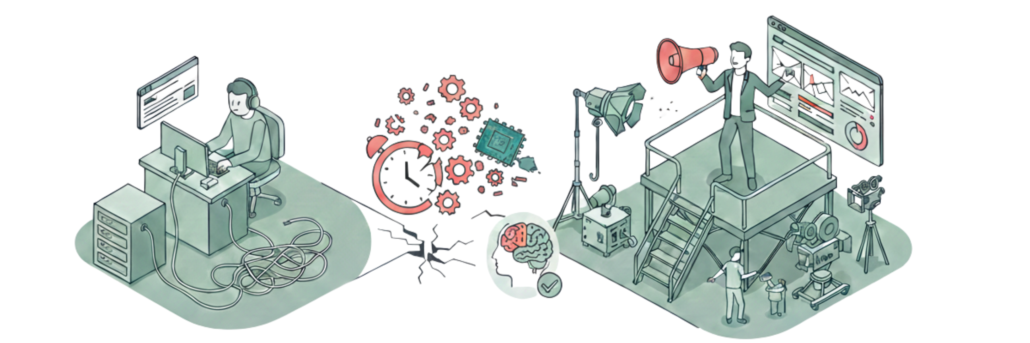

Most companies are not failing at AI because they chose the wrong tools. They are failing because they are training their employees to be typists.
The numbers tell a frustrating story: roughly 70% of companies report using AI, yet fewer than 40% of employees say they’ve received any training to use it effectively. Leadership invests in the technology, watches results disappoint, and quietly concludes the hype wasn’t worth it. But the technology is not the problem. The training philosophy is.
Most corporate AI training teaches people how to operate a tool: which buttons to click, which keywords to trigger the right output. This is the wrong frame entirely. In a B2B environment, prompting is the easy part.
The hard part, and the part nobody is teaching, is direction: knowing what you actually want, how to brief AI the way you’d brief a talented colleague, and how to evaluate what comes back. That is a leadership skill, not a technical one.
Effective AI training for employees must shift from an operator mindset to a director mindset. The benchmark is no longer ‘Are your employees using AI?’ It’s ‘Can they direct it?'”
The Search Engine Trap: Where AI Training for Employees Breaks Down
Most people treat AI like a search engine: type a question, get an answer, move on. That works for simple factual queries, but it fails for the complex work that actually moves the needle, like building proposals, synthesizing market research, or drafting customer communications. True AI training teaches employees to treat AI as a collaboration skill, not a search technique.
The shift that changes everything is realizing that AI functions as a capable colleague, not a vending machine. You wouldn’t hand a new hire a single sentence and expect a polished deliverable. You’d explain the objective, share relevant context, define the constraints, and refine together through back-and-forth dialogue.
The same logic applies to AI. The quality of what you get back is directly proportional to the quality of what you bring to the conversation. That means sharing the “why” behind a request, not just the “what.” It means specifying your audience, your constraints, your preferred format, and what success actually looks like. And it means treating the first output as a draft to react to, not a final answer to accept or reject. The professionals who get the most out of AI aren’t the ones with the cleverest one-line prompts. They’re the ones who know how to brief, iterate, and push back, the same skills that make someone effective when working with any talented colleague.
The Five Elements Every AI Training Program Should Cover
If the AI produces a bad result, the failure usually lies in the delegation rather than the algorithm. Directing AI requires the same clarity you would use when managing a human team.
To move from “prompting” to “directing,” employees must master the Five Elements of Effective Delegation:
The Five Elements Every AI Training Program Should Cover
If AI produces a bad result, the failure usually lies in the delegation rather than the algorithm. Directing AI requires the same clarity you would use when managing a human team. Vague instructions produce vague output. Precise direction produces work worth using.
To move from “prompting” to “directing,” employees must master five elements of effective delegation.
1. Set Clear Context
AI does not know your company’s culture, your buyers’ hidden preferences, or the political dynamics of your industry. If you do not share the background and the “why,” the AI defaults to the average of all the mediocre writing on the internet.
Most people skip context entirely. The result is output that is technically correct and completely generic.
- Weak direction: “Write an email to prospects about our new feature.”
- Strong direction: “I need to email IT directors at mid-market manufacturing companies who are evaluating ERP platforms. These are technical buyers who are skeptical of vendor claims, frustrated with implementation timelines from competitors, and want to understand specifics rather than benefits language. Our new feature addresses the integration bottleneck they consistently cite as their biggest pain point. The email should acknowledge that pain directly and lead with proof, not promises.”
The difference in output quality between these two directions is not marginal. It is the difference between something you delete and something you send.
2. Define the Mission
“Write something good” is not a mission. A director specifies the outcome: what decision should the reader make, and what action should they take as a result of engaging with this content?
Left undefined, AI will optimize for sounding complete rather than achieving anything specific. In B2B terms, a well-defined mission sounds like:
- “Help me explain our Q3 product updates in a way that makes existing customers feel confident in their investment and curious enough to book an expansion call.”
- “Write a competitive comparison that gives our sales team a confident, specific answer to the question they hear every week: why you and not them? It should be honest about where we lose and clear about where we win.”
- “Summarize this 40-page RFP in a way that helps our response team immediately identify where we are strong, where we have gaps, and where we need to make a judgment call about whether to respond at all.”
That is the difference between asking for content and commissioning work with a purpose.
3. Establish Quality Standards
Is this a rough draft or a polished final? A first pass for internal alignment or something going to a C-suite buyer? A source document for a writer to work from or the finished article itself?
Setting the bar upfront lets the AI calibrate accordingly and saves you from being disappointed by output that was never meant to be final. If you are not sure what you need, ask for both: a fast version and a more thorough one, then decide which direction to develop.
You can also specify what “quality” means for a particular piece:
- “This should be tight enough that a CFO reads it in 90 seconds and knows exactly what we’re asking for.”
- “This is a first draft for internal review only. Prioritize completeness over polish.”
- “Every claim in this document needs to be something we can defend in a procurement conversation. Flag anything that feels like a stretch.”
4. Specify the Deliverable
Left to its own devices, AI defaults to bullet points for everything. A director specifies the format before the AI begins, because format is not a small detail in B2B communication.
A C-suite reader and a technical evaluator need the same information presented in fundamentally different ways. Do not leave that decision to the AI.
- “Write this as flowing prose, no headers, no bullets. It’s an executive summary and needs to read like a considered point of view, not a list.”
- “Give me a structured comparison table: our solution vs. Competitor A vs. Competitor B across these six dimensions. One row per dimension, one short phrase per cell.”
- “This is a follow-up email after a discovery call. Three short paragraphs: what we heard, what we’d recommend, and a single clear next step. No more than 150 words.”
- “Structure this as a tiered proposal outline: executive summary at the top, technical detail in the middle, pricing and terms at the end. Each section should be able to stand alone for a reader who only looks at their part.”
Specifying format upfront is faster than reformatting after the fact, and it signals to the AI that you know exactly what you need, which tends to improve everything else about the output.
5. Give Permission to Push Back
This is the most underused move in AI direction, and often the most valuable.
Before asking for any output, say: “Before you start, what questions would you need answered to do this well? What information am I not giving you that would meaningfully change your approach?”
That single prompt transforms AI from an order-taker into a thinking partner. In complex B2B contexts, where the right answer depends on buyer persona, deal stage, competitive positioning, and internal politics, this step often surfaces the gaps in your own brief before a single word is drafted.
You can also use this technique mid-task:
- “You’ve given me a first draft. What assumptions did you make that I should know about?”
- “What would you do differently if you knew this was going to a skeptical technical buyer rather than a business sponsor?”
- “What’s missing from the brief I gave you that would have helped you do this better?”
Professionals who build this habit stop blaming the AI for bad output and start treating every interaction as a brief worth improving. That shift in mindset is, ultimately, what separates effective AI directors from people who are perpetually disappointed by the tool.
The “Yes, And” of AI Collaboration
In improv comedy, the fundamental rule is “Yes, And.” You accept what your partner offers and build on it. AI collaboration works the same way.
The first response is a starting point, not a finished product. Employees who reject an output and start from scratch are making requests. Directors iterate.
In practice, iteration sounds like this:
- “This is good. Can you make the tone more direct and cut the length by a third?”
- “That covers the main points. Now add a specific example relevant to enterprise procurement cycles.”
- “That framework makes sense. How would it apply to a mid-market SaaS company selling to HR teams specifically?”
Each exchange moves the work forward. The quality of the final output depends entirely on how well you sustain that back-and-forth. In B2B, where a single deliverable might go through legal review, executive sign-off, and multiple stakeholder edits, the ability to iterate efficiently with AI is not a nice-to-have. It is a core productivity skill.
The Director’s Responsibility: Verifying, Not Just Delegating
Direction without oversight is its own kind of recklessness. AI can now build financial models, analyze market data, and synthesize competitive research. But none of that output should be accepted without scrutiny, particularly in B2B contexts where a bad number in a proposal or a misattributed claim in a pitch deck has real consequences.
Two habits separate effective directors from passive users.
Habit 1: The Chain of Thought Probe
When AI produces analysis or a recommendation, your first move should be to ask it to show its work:
- “Can you walk me through how you arrived at this?” This forces the AI to expose its reasoning. Weak assumptions tend to surface here, and in a B2B setting that’s especially important when AI is summarizing competitor positioning, interpreting market data, or making claims about buyer behavior.
- “Now argue against your previous answer. What are the 3 strongest counterarguments?” This counteracts AI’s natural tendency to make things sound workable and surfaces fragility before you’re committed to a direction.
- “What are 5 inputs that would break this approach? Be adversarial.” Useful any time you’re pressure-testing a recommendation or strategy.
For particularly high-stakes work, try this built-in review loop that puts the stress-testing burden on the AI rather than on you after the fact:
“First, answer the question. Second, list 3 ways your answer could be wrong. Third, verify each concern and update your answer.”
Habit 2: Creating Space for Uncertainty
Most AI errors involve overconfidence and poor weighting of evidence. The fix is to build uncertainty into the prompt itself rather than trying to detect it in the output afterward.
- “If you’re not confident in something, say so rather than guessing.” A simple instruction that meaningfully improves honesty and usefulness.
- “Rate your confidence 0 to 100 for each claim. Flag anything below 70 as speculative.” This is especially valuable in B2B contexts where a misattributed statistic or overstated market claim has real consequences in a proposal or pitch deck.
In a B2B context, knowing which outputs to trust and which to verify before they reach a client is often more valuable than the output itself.
A good director doesn’t just want answers. They want to know which answers to act on.
The Real Benchmark for AI Training for Employees
“Strategy without tactics is the slowest route to victory. Tactics without strategy is the noise before defeat.” — Sun Tzu
Most AI training programs are teaching tactics. What they are not teaching is strategy: knowing what you want, how to brief AI toward a specific outcome, and how to evaluate what comes back. The result is exactly what we see across B2B organizations — a lot of noise, and very little victory.
The honest benchmark for AI readiness is not how many licenses you have purchased or how many employees completed an introductory course. It is whether your people can:
- Brief AI with enough context to get relevant output
- Define a clear outcome rather than a vague request
- Iterate toward quality rather than accepting the first response
- Verify reasoning before anything goes client-facing
The question worth asking across every team and function is not “Are your employees using AI?” It is “Can they direct it?”
If the answer is not a confident yes, that is exactly what our AI training and mentoring program was built to address. We work with B2B teams to close the gap between AI adoption and AI fluency, so your people stop prompting and start directing.