

Every week brings a new headline warning about a robot takeover. “AI is coming for your job,” or “Will ChatGPT replace marketing departments?” It’s easy to get swept up in anxiety. But focusing on whether machines will replace us misses the point.
The real issue isn’t whether AI will replace people. It’s that most professionals still spend the majority of their day on tasks AI can already do faster. That’s not a technology problem. It’s an adaptation problem.
At Cascade Insights®, our work in the B2B tech space gives us a front-row seat to how this is actually playing out inside organizations. What we see isn’t a wave of replacement. It’s a shift in where human effort needs to go, and a widening gap between teams that have internalized that shift and those that haven’t.
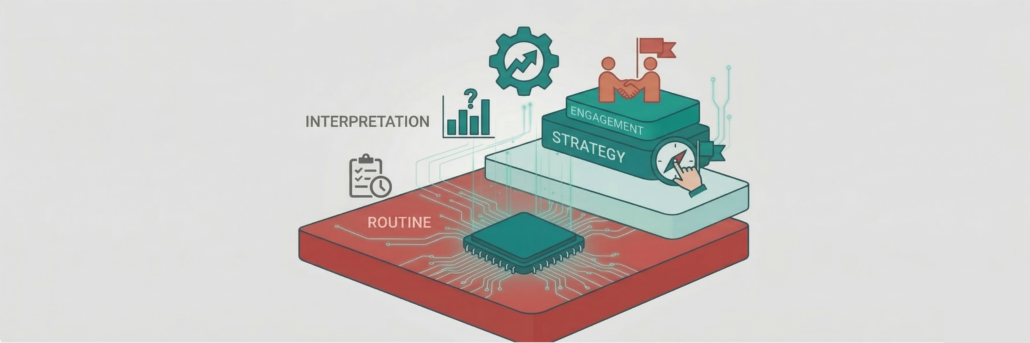
To understand it, we use the RISE Framework: Routine, Interpretation, Strategy, and Engagement. Each level clarifies where machines are taking over and where people remain irreplaceable.
Routine: Let It Go
At the foundation is Routine work, the repetitive, predictable tasks that make up a surprising portion of most workdays. Scheduling. Data entry. Slide formatting. Server log monitoring. Basic code. If you can write a checklist for it, AI can execute it. And it will do so around the clock, without a break.
Just as machines replaced physical labor during the Industrial Revolution, AI is now handling the basic “symbol processing” jobs: writing, calculations, and code generation. Yet many professionals cling to these tasks. Routines feel safe and familiar. In an AI-powered world, they’re a liability.
Speed is where AI always wins. A manual meeting summary might take 45 minutes. AI transcribes and summarizes in under a minute. If your value proposition rests on being fast at routine tasks, that’s a problem, not because AI is unfair, but because speed at routine work has become a commodity.
The solution isn’t to hold on. It’s to automate, delegate, and redirect your time to work that matters more.
Interpretation: The “So What?” Still Belongs to You
The next level is where things get more nuanced. AI is genuinely powerful at Interpretation. It can process massive datasets, surface trends, and flag anomalies in seconds. The competitive advantage that once came from gathering and organizing information has largely evaporated.
But here’s what AI still can’t do: decide why something matters.
AI can tell you that sales in manufacturing are down 15%. It takes a human, one who understands the business context, the recent pricing change, the sales rep who just left, to know what to do with that. Judgment means knowing what data to trust, what to question, and when a pattern is noise versus a signal.
AI reveals what’s happening. Humans determine what it means. That distinction is where real analytical value lives, and it’s the part of interpretation that’s hardest to automate.
Strategy: Accountability Can’t Be Delegated
Moving up the framework, we find Strategy, and this is where the human-versus-machine dynamic becomes unambiguous.
AI can simulate scenarios, stress-test plans, and generate a dozen go-to-market strategies for a security-focused SaaS company in healthcare. It can assign probabilities to each outcome and rank them by likelihood of success.
What it cannot do is take responsibility for any of them.
Genuine strategy requires ownership. Someone has to stand in front of a board, put their name behind a direction, and answer for the outcome if it goes sideways. AI can inform that decision. It cannot make it on behalf of a person or organization. The accountability gap is not a technical limitation. It’s fundamental to what strategy actually is.
Engagement: The Highest-Stakes Human Domain
At the top of the framework sits Engagement: building trust, leading teams, navigating difficult conversations, and negotiating deals where relationships are on the line.
AI is making inroads here too. Chatbots handle straightforward customer requests. Automated systems manage low-stakes outreach. But the most sensitive and consequential interactions remain stubbornly human.
Peter Drucker put it well: “The most important thing in communication is to hear what isn’t being said.”
Complex negotiations, difficult performance conversations, and client relationships built over years, these aren’t areas where finding the right words is the challenge. It’s about empathy, nuance, and shared stakes. When the outcome matters most, people want a real person across the table.
The Cost of Getting It Wrong Goes Up at Every Level
Here’s the through-line that ties the framework together: the higher you go, the more costly a mistake becomes.
A scheduling error or poorly worded automated email is a small problem. A missed trend from faulty data costs opportunities. A bad strategic call can threaten a company. A failed negotiation, or a leader who can’t read the room, can end careers and reputations.
This is why the push toward higher-value work isn’t optional. The assembly line moved workers into higher-skilled roles during industrialization. The same shift is happening now, and it’s moving faster.
The Real Competitive Edge Is Knowing Where You Need to Be
The teams that are thriving aren’t spending their energy competing at the Routine or Interpretation levels. They’re focused on developing the judgment, accountability, and human connection that define Strategy and Engagement, and they’re using AI to clear the path to get there.
That transition doesn’t happen on its own. It requires deliberate reskilling: not just training people on tools, but helping them redesign how they work, where they add value, and how to use AI as a force multiplier rather than a distraction.
Ready to help your team move up the value chain?
At Cascade Insights®, our AI Training & Mentoring programs are built specifically for B2B organizations navigating exactly this shift. We don’t do one-size-fits-all lunch-and-learns. We work with your teams to build real fluency, redesign workflows, and develop the strategic and engagement capabilities that AI can’t replicate.