

At a Glance
Challenge: Building AI capability across an academic institution, including faculty, students, and partner organizations, in a fast-moving landscape where tools and best practices shift constantly.
Solution: A sustained, multi-track engagement beginning with a summer faculty seminar series, expanding into a real-world AI consulting course with external partner organizations, and continuing through ongoing monthly training tailored to beginner and advanced faculty groups.
Results: Faculty entered the academic year more prepared to integrate AI into their teaching; students gained hands-on consulting experience with real organizations; partner organizations received practical AI training; and a continuing monthly program keeps faculty current as the field evolves.
The Challenge: Why AI Integration in Higher Education Is Harder Than It Looks
Our client engaged Cascade Insights® to design and deliver a structured AI training program that would directly address uneven AI adoption across the organization, moving staff toward more consistent, confident use while meeting them where they were, regardless of their starting point.
The goal was more than simply to increase tool usage. It was to build real organizational capability around AI, with employees who understood where AI creates leverage, what should and shouldn’t be delegated to it, and how to apply it responsibly within their specific roles.
The Objective: Building AI Capability Across Faculty, Students, and Partner Organizations
The engagement was designed to build AI capability at multiple levels simultaneously. That meant helping faculty across all departments integrate AI into their teaching thoughtfully and confidently. It meant giving students hands-on consulting experience with real organizations so they could see how AI applies in practice, not just in theory.
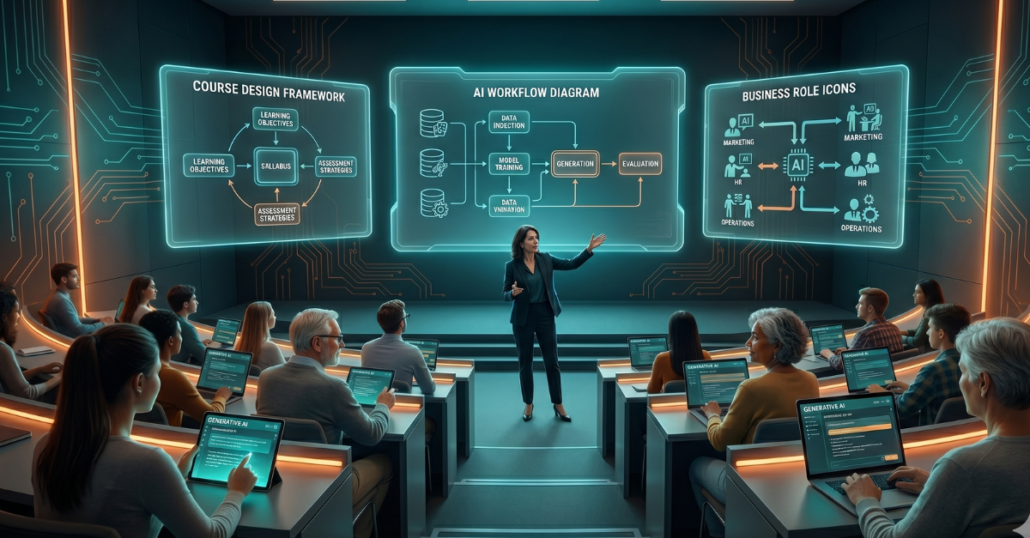
It also meant teaching a GenAI course that explores how AI is reshaping specific business roles, including marketing, sales, HR, operations, development, and executive leadership, giving students a clear-eyed view of where human judgment remains essential and where AI can meaningfully accelerate work. That course has since become a core requirement in the College of Business curriculum, one that every business school student now takes. And it meant providing ongoing training to keep instructors current as the tools and the questions around them continue to evolve.
The Approach: A Multi-Track Model for AI Integration in Higher Education
Effective AI integration in higher education doesn’t happen through a single intervention. It requires meeting people where they are, across different roles, experience levels, and needs. The engagement with this institution took three distinct forms.
Track 1: Faculty Summer Seminar Series
The work began with a series of four summer seminars designed for faculty across all departments, not just business. The goal was to help professors understand what was possible with AI before the academic year began, and to give them a foundation they could actually use in their classrooms.
Each seminar tackled a specific challenge in higher education’s rapid adaptation to AI:
- Getting Ready for Fall — An introduction to the current AI landscape, covering leading models, image and video generation tools, agentic AI, and workflow automation. Faculty experimented with tools that had often launched just days or weeks before.
- Developing a New Course with AI — How to use AI to design or significantly update a course, and how to incorporate AI into assignments and learning activities that foster genuine engagement.
- AI-Resistant Assignments — How to design assignments that require personal perspective, reflection, and synthesis. Work that resists surface-level AI output and keeps students building the skills that matter most.
- Grading and Assessment in an AI Era — How to fairly evaluate student work when AI may play a role, including how to adapt rubrics, recognize responsible AI use, and reward critical thinking.
The seminars blended structured workshops with one-on-one mentoring, giving faculty across disciplines the space to explore AI in ways relevant to their own teaching.
Track 2: Real-World AI Consulting Course
Each semester, Sean Campbell (Cascade Insights®’ CEO and an Assistant Professor of Artificial Intelligence) teaches a course in which students act as AI consultants for real organizations. Rather than working through hypothetical case studies, students assess actual workflows, identify where AI can add value, and develop recommendations that connect technology capabilities to real business goals.
This past spring, students worked with a strong roster of partner organizations spanning regional broadband and connectivity providers, a leading aviation and aerospace museum, professional audio and video services, as well as the university marketing team, who joined as an additional client. In each case, the engagement included hands-on AI training or mentoring delivered directly to the partner organization, meaning the course created real capability not just for students, but for the businesses they served.
Track 3: Ongoing Monthly Faculty Training
Faculty training hasn’t stopped after the summer seminars. Training for faculty has continued on a monthly basis, serving both beginner and advanced groups as their needs evolve. Sessions focus on the AI tools the institution has adopted, along with other best-of-breed tools where appropriate. Beyond the regular monthly cadence, the program also includes custom workshops designed around the particular needs of individual professors, recognizing that a faculty member teaching finance has different questions about AI than one teaching data analytics, organizational behavior, or marketing.
The ongoing nature of this work reflects something important. AI integration in higher education isn’t a one-time event. The tools change, faculty comfort levels grow, and new questions emerge each semester. Staying current requires a consistent, evolving relationship rather than a single intervention.
The Results: What Sustained AI Integration in Higher Education Actually Produces
Across all three tracks, the engagement demonstrates what it looks like to build AI capability at scale within an institution, not through a single program, but through multiple touchpoints designed for different audiences and purposes.
Faculty across departments entered the academic year with a working understanding of AI tools and practical strategies for integrating them into their teaching. Students in the consulting course gained real-world experience that bridges classroom learning and professional practice. The partner organizations they worked with received hands-on AI training tailored to their actual workflows. And ongoing monthly training ensures that faculty continue to develop their skills as both the tools and their own confidence evolve.
This is what meaningful AI integration in higher education looks like in practice: not a rollout, but a relationship. Not a single session, but a sustained commitment to building capability at every level of the department or institution.