

Sean Campbell, CEO of Cascade Insights®, writes about AI and the people who use it in his LinkedIn newsletter, The Human Side of AI. Subscribe there to get each new edition.
Plus: 14 AI links, stories, and tools worth your time this week. Jump to the roundup ↓
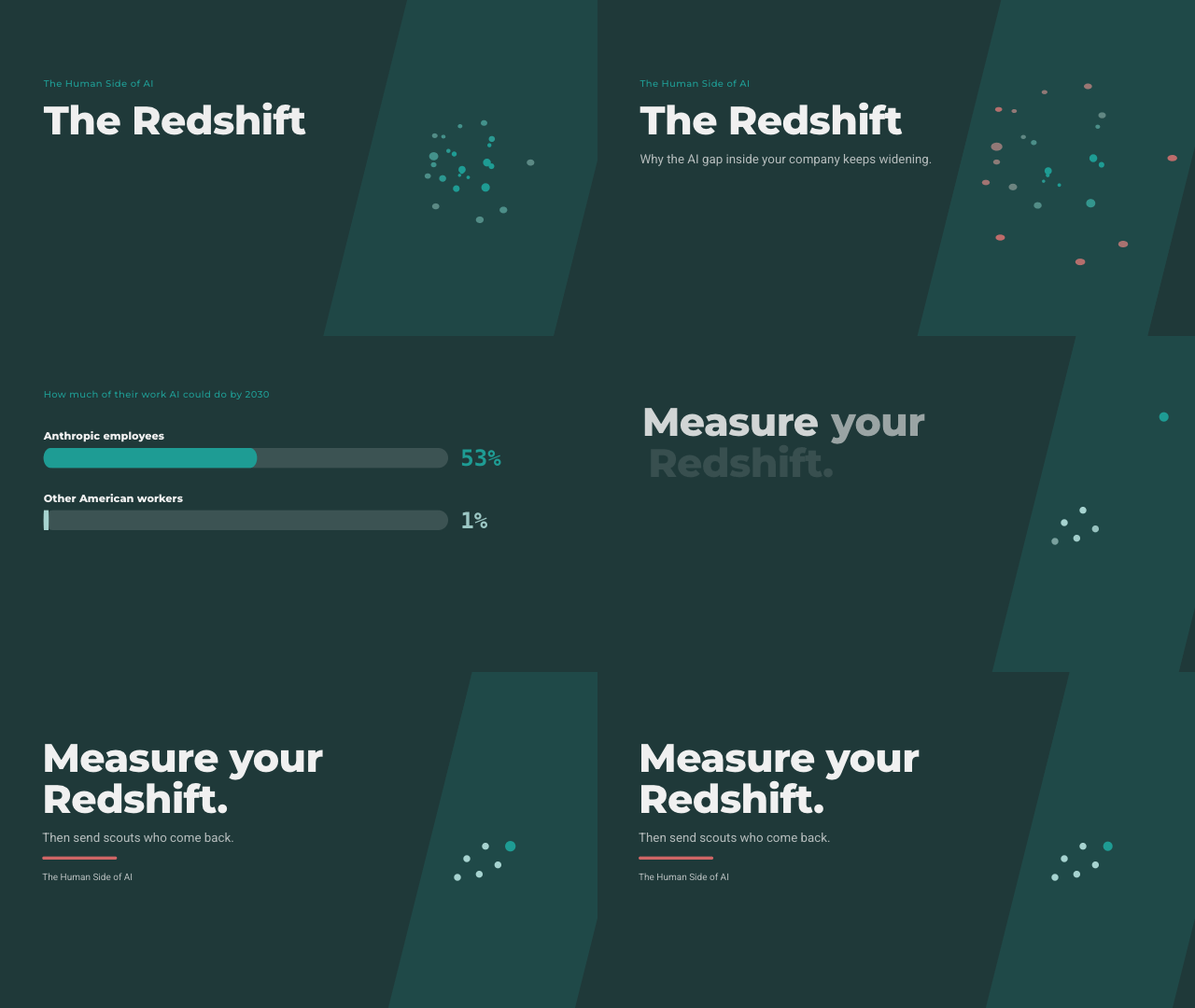
Anthropic’s employees expect AI to be able to do 75% of their work by 2030. Other American workers put that number at 28%. Same year, two very different views of what’s possible. I’ve started calling that gap the Redshift.
In astronomy, redshift is how you can tell galaxies are moving away from us. Their light gets stretched on the way here, and the farther away a galaxy is, the faster it recedes. I think something similar is happening inside companies right now, between the people working at the AI frontier and everyone else. And I think the distance is growing faster than most leaders realize.
That’s a different shape from the technology adoption curve most of us in tech grew up with, the one Geoffrey Moore made famous in Crossing the Chasm.
The chasm was supposed to be crossable
I’ve spent most of my career studying how B2B buyers evaluate and adopt technology, and for most of that time the adoption lifecycle held up pretty well: innovators, early adopters, then the chasm, then the pragmatists and conservatives.
Moore’s big idea was that the gap between early adopters and the pragmatic majority could be crossed. Pragmatists wanted to see peers succeed first. They wanted references, a more complete product, and some assurance that they weren’t making a career-limiting decision. So the product matured, the success stories piled up, and eventually more of the market came across. The technology kept improving, but organizations had time to learn from the people who went first.
AI makes that much harder. I keep hearing the same thing from those of us out on the frontier. Whatever workflow you build today may look very different in three to six months. Sometimes in a week, given how fast the releases land.
The chasm only works if the far side holds still long enough for everyone else to get there. This one doesn’t hold still.
When the capabilities improve, the frontier moves. Anthropic studied its own workforce and found that when a new model becomes available, employees almost immediately start giving their AI agents harder problems. People at the frontier use each new model to take on work they couldn’t do before. So the frontier doesn’t sit at the edge of the chasm waiting for everyone else. It keeps going.
And it’s speeding up
There’s a second astronomy lesson in here. For most of the last century, astronomers assumed the universe’s expansion was slowing down. In 1998, two research teams found the opposite: it’s speeding up. That’s the version of the Redshift that worries me.
Because the thing pulling the frontier forward is now helping build itself. Earlier this month METR, an outside evaluator that spent eleven weeks inside Anthropic, reported that the company is improving its models at about twice its earlier pace, and that most of the speedup likely comes from using AI to do the AI research. METR is careful to call that a rough estimate, and it’s one lab. But Anthropic’s own staff say AI already does about half the work of building a new frontier model, and they expect that to hit 80% by the end of 2027.
The name for where that trend ends is recursive self-improvement, a model that can design its own successor. Anthropic says it isn’t there yet, and that getting there isn’t inevitable. I don’t need it to arrive for the Redshift to get worse. If each model shows up sooner than the last one did, the people who rework their jobs with every release get more turns. And the people waiting for things to settle down never get the settled moment they’re waiting for.
At the frontier, people are the bottleneck
One Anthropic researcher told METR they’re “now only bottlenecked on ideas & compute, no longer bottlenecked on code.” At one of the most AI-native companies in the world, code is becoming less of the constraint. Ideas still matter, and so does the judgment to decide which ones are worth pursuing.
In Anthropic’s workforce report, Claude agents spent about 80% of their interactive session time waiting for human input. Even for non-technical employees, just reading everything their agents produced would take more than half the work week.
The agents can produce work faster than people can absorb it. They can keep going, but someone has to decide what happens next. Someone has to define the problem, point the agent at it, judge what comes back, and sometimes imagine an entirely different way to do the work.
That’s the constraint a lot of companies are going to run into. You can hand everyone the same AI tools in an afternoon. Willingness to experiment, the ability to delegate, and imagination about what might be possible take a lot longer to spread.
You can see the shift in Anthropic’s hiring. Its managers increasingly emphasize autonomy and judgment, and give relatively less weight to specific technical expertise. Figuring out what needs doing is becoming as valuable as doing it yourself.
Faster versus different
Right now, most of the distance comes from what people point AI at.
On the near side of the chasm, AI speeds up work people already did. The email gets drafted faster and the meeting gets summarized. That’s worth having, and I’m not knocking it. But the job on Friday looks like the job on Monday, just with a little more room in it, or simply more of it.
At the frontier, people use it to take on things they couldn’t do before, or wouldn’t have bothered to try. Anthropic’s report describes a recruiter who had Claude run an analysis that would have taken him a couple of weeks. He spent the time he got back redesigning outdated interview questions and meeting more candidates. Another employee described the strategic fifth of the job turning into nearly all of it.
Inside one company, that can look like two people with the same title, access to the same tools, and increasingly different jobs. One is using AI to help write a report. The other asked what the report was for, and stopped writing it. They built something that watches the same information every day and tells the people who used to read the report when there’s a decision to make. The second person may be no more technical than the first. They’ve learned to think differently about what they’re responsible for doing themselves.
And this is why the two groups pull apart instead of converging. A faster email is still an email when the next model ships. The person who rebuilt the work gets to rebuild it again, this time even better.
The gap compounds
Put those things together and the old chasm starts looking different. Every improvement gives the people most comfortable with AI another chance to change how they work. The people waiting to see what happens are still moving too. Relative to the frontier, though, they’re falling farther behind.
You can discount the Anthropic numbers if you want. They build a leading AI model, and they’re describing themselves. So look at somebody else’s customers.
OpenAI found a version of this pattern across its enterprise accounts late last year. Its most active users, those at the 95th percentile, send six times as many messages as the median employee. OpenAI calls them frontier workers, and says the gap between them and the median is widening. Message counts aren’t the same thing as productivity, but the difference in how deeply people engage is hard to miss.
The redshift metaphor has a darker side too. Some galaxies are moving away so fast that their light will never reach us.
In a company, I think that’s the moment your frontier people stop explaining what they’re doing, because nobody seems to be listening, or because explaining takes time they’d rather spend building the next thing. Or they leave for a company where people actually listen to them.
Measure your own Redshift
Most AI dashboards count logins, licenses, and maybe prompts. They tell you who’s showing up, but they say very little about how differently people are working.
I’d start with Anthropic’s question instead. Ask your heaviest AI users and your typical employees how much of their current work they think AI could do by 2030. The distance between those two answers is your Redshift.
Then look at a few behaviors in each group. How often do they hand off an entire task rather than asking AI for help with one step? How often are their examples of AI use focused on speeding up the work versus reimagining it? When was the last time they changed how they approach a recurring piece of work? And maybe most important, what are they doing now that they never did before, and what do they consider possible that they wouldn’t have considered six months ago?
You won’t get a precise score, but you’ll learn more about the real state of AI adoption than another dashboard of weekly logins will tell you.
Scouts who come back
This isn’t physics. The distance doesn’t have to keep growing, but both sides of the gap have some work to do.
First, the people at the frontier need to turn around occasionally. Exploring is the fun part, and I get that. Discovering you can do something in your job you never thought possible, something that goes beyond a mere speed improvement, is exciting. The harder, more generous part is coming back and helping other people see what you’ve found.
That might mean a small team whose job is to test new models and workflows and bring what works back to everyone else. Or it might mean sitting with a colleague for an hour and building something useful together. In short, scouts who come back.
And those scouts may come from places you didn’t expect. In Anthropic’s report, a salesperson described building a custom dashboard connecting their tools in three or four hours, something they’d considered well outside their abilities. Across the company, coding-agent sessions among non-technical employees went from about two a month to 90 a month in less than a year. Sometimes the scout sits in sales.
The people back home have a responsibility too. There’s an old story in Numbers 13 and 14 about twelve scouts Moses sent into Canaan. They returned with a cluster of grapes so large it took two men and a pole to carry it. All twelve agreed the land was good. Ten said the people living there were too strong to overcome, and described themselves as grasshoppers by comparison. Two, Caleb and Joshua, believed they could go forward. The crowd sided with the ten.
What strikes me is that nobody argued about the grapes. They could see the opportunity. They just didn’t believe they could handle what came with it.
A lot of people don’t need another demonstration that AI is powerful. They’ve seen the grapes. What they’re less sure about is whether they can do something meaningful with it themselves. And the reports coming back from the frontier often describe a place that looks nothing like the work they do every day.
Some of them aren’t sure they want their work to change that much, either. Even people who ended up on the frontier will tell you that was their first reaction: “I didn’t want to give up writing, drawing, programming.” That’s a fair thing to feel, and another cluster of grapes doesn’t always answer it when your team is focused on the giants.
Not everyone needs to be a scout
Most people aren’t going to spend their evenings testing new models, and they shouldn’t have to. Their part is smaller than that. Take the report seriously enough to try one thing, with someone who’s been out there.
The one thing can be small. Pick a piece of work you do every month and know cold, like the report that takes three rounds of edits or the update that always lands a day late. Bring it into a room with a few teammates and someone who’s been out there, and spend an afternoon working through it together. What does a good result look like, and where do you still need to step in?
You know that work better than any scout does, so you’re the one who can tell whether what comes back is any good. And you leave with something you’ve tested on your own work, which is a much smaller ask than changing your whole job. It’s also harder to feel like a grasshopper when the work on the table is yours.
To do that, people need time to learn, room to try things without looking foolish, and help connecting new capabilities to work they care about. They also need someone to take their concerns seriously. Not every hesitation is resistance. Sometimes the person asking about quality or accountability is raising something the enthusiastic builder hasn’t thought through.
Another CEO email about how “everything is changing!” and how we all need to work harder until morale improves won’t help much. It mostly makes the person who fears the giants feel worse, and less likely to reimagine their work. In fact, it leads to more speeding up and less reimagining, because speeding up is a defensive move. Yes, boss, I can do more of my job, faster, for less. Plus, that move shows results in the near term, even if it leaves your company behind in the long term. The advantage will go to the company that gets to tomorrow’s version of the work first.
Even Anthropic has planned for this. It’s built ways to identify roles likely to be disrupted, and it prioritizes moving employees into new positions as their work changes. One Anthropic executive put it this way: “a workforce that is anxiously worried is not a workforce doing its best work.” If you’re trying to close the gap, fear is a poor operating model.
What I’d watch for
My prediction is that most companies will keep measuring AI adoption by logins and licenses, because those numbers are easy to collect and look like progress. Then, a year from now, they’ll realize that a handful of employees are doing different jobs from everyone else, and that the gap grew while they were counting.
The leaders who get ahead of that will be the ones who see the distance early and make bringing people along as important as getting farther ahead.
Leaders, if you measured your Redshift today, how far apart would the answers be? And for those of you already out on the frontier, who’s one person you could bring with you this month?
What caught my eye in the world of AI this week
Nvidia, Chips & China
- Jensen Huang resigns as Nvidia CEO Nvidia’s board announced his resignation as CEO and board member effective immediately, naming CFO Colette Kress interim CEO and Harvey C. Jones the company’s first-ever board chair.
- Top Chinese labs trained their newest models on banned Blackwell chips, per Will DePue The former OpenAI researcher claims forensic evidence shows DeepSeek, Moonshot, MiniMax, and Ant Group built on Nvidia chips that are barred from export to China.
- The CUDA moat is gone, per Marcelo P. Lima He says it took Mythos three days to work out how to run itself on AMD hardware.
Model Watch & New Releases
- Google introduces Gemini 4 Hydrogen Google’s new model, pitched as its daily driver for agentic workflows, out November 12.
- Fable 5.2 built a complete game from one-shot prompts (Felix Rieseberg) Models, sounds, and textures all came from scratch with no human feedback, for roughly $550 at API pricing over eight hours.
Office Suites & Meeting Bots
- Anthropic adds Claude Sheets, Whiteboards, and full-app interactive connectors Sheets and Whiteboards arrive as new artifact types, and interactive connectors now open a partner’s app beside the chat or full screen so Claude can work in it.
- Claude Meetings brings Claude into team video calls It builds docs, whiteboards, and other artifacts while the call is still going, rolling out in beta on Team and Enterprise plans.
- Grok Bot can now join meetings It takes questions, accepts assigned work, and keeps track of what the team decides.
- WordPress running inside Claude through interactive connectors, per Utsav Ladani
Agents at Work
- Why multi-exec matters for OpenAI’s Dots agents, per pash An OpenAI engineer walks through a Dots feature that shipped quietly the previous Friday.
- Claude reverse-engineered a 32-year-old Jeep, then started controlling it
- Oddboro: an open-source pixel office staffed by AI workers It runs on Mac, Windows, or Linux, and users pick an Office Manager, watch the floor, and set how far each AI worker can go.
- Open-source skills that teach agents to build better interfaces A free set covering animation, gestures, and mobile polish, aimed at designers and engineers.
Work & Careers
There is no moat for digital work (Tomas Pueyo) Pueyo argues digital workers’ skills are turning into a commodity, starting with SaaS, and lays out sixteen moats that might still hold.