

For years, B2B marketers have worked to understand how buyers move from recognizing a problem to researching solutions, evaluating vendors, and ultimately making a purchase. We’ve built entire strategies around that journey, investing in SEO, thought leadership, buyer personas, and carefully mapped content funnels to reach buyers at the right moment.
But what happens when buyers stop following that familiar path? Imagine you’re a VP of Operations looking for a new warehouse management solution. A few years ago, you might have started with Google, read analyst reports, visited vendor websites, and gradually narrowed your options. Today, you can ask ChatGPT to compare leading solutions for your specific environment, summarize their strengths and weaknesses, and recommend three vendors worth considering.
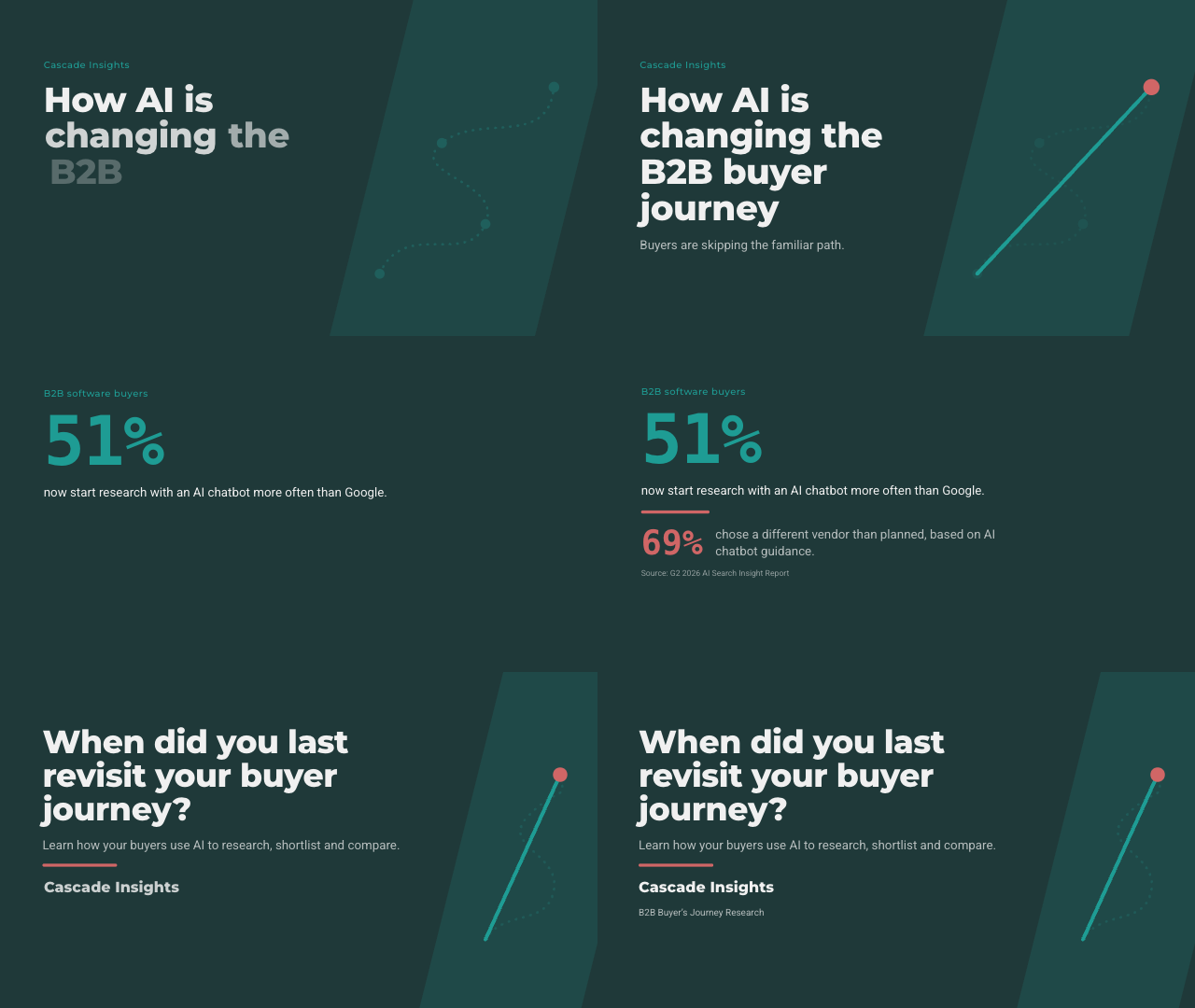
In minutes, you’ve gone from recognizing a need to having a preliminary shortlist. You might not have visited a single vendor website. According to G2’s 2026 AI Search Insight Report, 51% of surveyed B2B software buyers now start their research with an AI chatbot more often than Google. Even more striking, 69% reported choosing a different vendor than initially planned based on AI chatbot guidance.
The AI B2B buyer journey is taking shape, and it has implications well beyond how companies appear in search results. AI is already influencing which vendors buyers discover, what information they encounter, and how they evaluate alternatives. And as AI agents become more capable of independently selecting and using software, we’re approaching another shift: a buying process where technology itself may influence which products get chosen, sometimes with limited human involvement.
For B2B technology companies, that raises a question worth investigating: How well do you actually understand the way your customers buy today?
1. AI Has Already Changed How B2B Buyers Discover Products
The shift in how people discover information online is already having measurable consequences. During Reddit’s October 2026 earnings call, CEO Steve Huffman revealed that the platform was losing more than one million search referrals per week on average. He pointed to Google’s AI Overviews and AI Mode as the likely primary drivers, explaining that these experiences increasingly provide answers without sending users to the websites supplying the information.
For marketers, that should raise some alarms. Even a platform as widely recognized as Reddit is feeling the effects of AI-powered search. And if fewer people are clicking through to websites, companies may have less visibility into when and how potential customers are discovering them.
For B2B technology buyers, the implications go further. Rather than searching for “best enterprise cybersecurity platforms” and reviewing ten different websites, a buyer might ask ChatGPT:
We’re a 500-person financial services company migrating to a hybrid cloud environment. Which cybersecurity platforms should we consider, and how do they compare on integration, compliance, and total cost of ownership?
Within seconds, that buyer could have a preliminary shortlist, complete with comparisons and recommendations, without visiting a single vendor website.
Consider Notion. In a November 2026 Department of Product analysis, the company was highlighted for reporting that AI tools accounted for 25.4% of responses to its user survey asking how people discovered Notion, making AI its leading reported discovery source.
These developments raise important questions for B2B marketers. Which prompts are buyers using? Which vendors appear in AI-generated recommendations? What information influences those answers? And how often are buyers accepting an AI-generated shortlist without exploring alternatives?
As AI changes where discovery happens, companies need a clearer understanding of how their buyers are finding and evaluating potential solutions, especially when those interactions happen before a prospect ever reaches their website.
2. AI Is Changing How Buyers Evaluate Vendors
Discovery is only the beginning. Once buyers identify potential vendors, AI can help compare features, summarize customer reviews, explain technical differences, and identify tradeoffs.
Semrush’s 2026 research found that 72% of surveyed U.S. business professionals who use AI for work reported using it during early purchasing research, while 62% used it to compare vendors. That creates a different evaluation experience. Historically, vendors could shape much of the information buyers encountered through websites, sales presentations, product demos, and marketing materials. Now, AI can assemble comparisons using competitor websites, customer reviews, analyst coverage, technical documentation, and other publicly available sources.
Imagine your company positions its software around implementation flexibility, while competitors emphasize ease of use. A buyer asks an AI assistant which solution is easiest to deploy. If the available information makes your product appear more complicated, your company may be disadvantaged before having an opportunity to explain why its flexibility matters.
This creates an important opportunity for competitive intelligence research. Companies need to understand how competitors are positioned in AI-generated comparisons, which claims influence buyer perceptions, and whether their own differentiation comes through accurately.
It also changes the conversations sales teams may have with prospects. Buyers can arrive with detailed comparisons, preconceived opinions, and specific concerns developed through AI-assisted research. Understanding those expectations can help marketers create more effective messaging and sales enablement materials.
3. What Happens When AI Joins the B2B Buying Committee?
B2B purchases rarely involve a single decision-maker. Depending on the product, purchasing decisions may involve IT, finance, procurement, department leaders, executive sponsors, and end users. Each stakeholder brings different priorities, from security and integration to cost, usability, and operational impact.
Now AI is becoming another influence in that process. An AI assistant might help a department leader create an initial shortlist, support an IT team evaluating technical requirements, or help finance compare total cost of ownership. Different stakeholders may use different tools and prompts, bringing AI-generated findings into the same buying process.
Consider a company evaluating a new CRM platform. The sales leader asks ChatGPT which system would best support the team’s workflows. IT uses Copilot to assess integrations and security considerations. Finance asks Claude to compare three-year costs. Each stakeholder arrives at the buying committee meeting with a different recommendation, supported by what appears to be a well-researched analysis.
Who determines which information is reliable? How are conflicting recommendations resolved? And how much weight should an AI-generated comparison carry alongside direct product experience, peer recommendations, and vendor conversations? These questions become particularly important when AI appears objective to the people using it. Buyers may not always recognize that recommendations can depend on the wording of a prompt, the sources available to the model, or incomplete product information.
G2’s 2026 buyer research found that 47% of surveyed buyers would allow AI agents to research and recommend products while keeping final decisions with humans. Another 21% would limit agents to research only.
For most complex B2B purchases, humans will continue to own the decision. However, AI may influence the information those humans consider long before they reach a consensus.
This creates a potential blind spot in traditional buyer journey research. Companies may understand who participates in purchasing decisions without knowing how those stakeholders use AI, whether they trust its recommendations, or how AI-generated information shapes internal discussions. For B2B marketers, understanding those dynamics could be just as important as knowing who holds the budget or signs the contract.
4. The Next Shift: When AI Agents Start Selecting Software
So far, we’ve explored how AI influences the decisions people make when evaluating vendors. But what happens when AI begins making some of those selections itself?
AI assistants can increasingly interact directly with software through integrations, APIs, and technologies such as the Model Context Protocol (MCP). Instead of requiring users to open multiple applications, these connections allow assistants to access tools and perform tasks across different systems.
Imagine an employee asking an AI assistant to compile a weekly competitive intelligence report. The assistant could retrieve information from connected services, organize findings, and generate a summary without the employee manually navigating each platform.
In that scenario, product selection may increasingly depend on how effectively software works within AI-powered workflows. This introduces the emerging concept of agent-market fit: how easily AI agents can discover, understand, integrate with, and use a product.
For software companies, it raises questions about whether their product documentation, APIs, integrations, and capabilities make them attractive options for AI-powered workflows. A competitor with stronger integrations could potentially become a preferred tool even without having the strongest brand recognition.
The implications will vary by category. Complex enterprise purchases still involve security reviews, procurement processes, contracts, and organizational approvals. But as AI agents gain more responsibility for completing work, the criteria buyers use to evaluate software may also evolve. For product and marketing teams, understanding these emerging expectations could become an important part of both go-to-market strategy and product development.
5. What Should B2B Marketers Do Differently?
With so much attention on AI search optimization, it’s tempting to respond by publishing more AI-friendly content, tracking brand mentions in ChatGPT, or improving technical website elements. Those activities may help, but they are most valuable when informed by an understanding of how actual customers use AI throughout their buying process. Here are four areas worth investigating.
Revisit Your Buyer Journey Research
If your buyer journey research is several years old, it may not reflect how customers currently evaluate technology solutions. Reexamine where buyers begin their research, which AI tools they use, what prompts they ask, and how AI recommendations influence shortlisting. Rather than asking buyers generally whether they use ChatGPT, have them walk through a recent purchasing decision and explain exactly where AI played a role.
Test How AI Represents Your Company
Run realistic buying scenarios through multiple AI assistants. Evaluate how accurately they describe your capabilities, positioning, pricing, and competitive strengths. Pay particular attention to the criteria your buyers value most. If integration with legacy infrastructure is a major competitive advantage, does that come through in AI-generated comparisons? If your product has a reputation for complexity, is that perception reinforced or challenged?
Understand AI’s Influence Across the Buying Committee
Different stakeholders may use AI for very different purposes. A technical evaluator may rely on it for feature comparisons, while a finance leader uses it to assess costs and a department head uses it to explore potential use cases. Understanding those differences can help marketers tailor content, prepare sales teams, and anticipate questions that arise during internal evaluations.
Investigate What Happens After the Shortlist
AI-generated recommendations may help buyers identify vendors quickly, but making the shortlist doesn’t guarantee a sale. Which claims do buyers verify? What causes them to reconsider a recommendation? When do they seek independent validation, contact sales, or involve additional stakeholders? These downstream behaviors can reveal valuable opportunities to improve positioning, content, and sales enablement.
Understanding the AI B2B Buyer Journey Starts With Your Buyers
AI is changing how B2B buyers discover vendors, evaluate solutions, and make purchasing decisions. Companies that continue relying on outdated assumptions about the buyer journey risk missing how their customers actually find and select solutions today.
When was the last time you revisited your buyer journey? Do you know how your customers are using AI to research vendors, build shortlists, and compare options? And more importantly, is your marketing strategy keeping up?
At Cascade Insights®, our B2B Buyer’s Journey Research helps you uncover how purchasing behavior is evolving so you can adapt your strategy accordingly. Connect with us to learn more.