

Sean Campbell, CEO of Cascade Insights®, writes about AI and the people who use it in his LinkedIn newsletter, The Human Side of AI. Subscribe there to get each new edition.
I’ve started letting an AI agent make a few calls for me. It does fine. It just doesn’t sound anything like me, and that’s been bugging me a bit, because at some point I’m pretty sure I’ll want it to sound like me.
I already have an AI that writes like me. It was built from a couple years of my sent email, and it gets my phrasing pretty close: the “etc.”s, the smiley faces, all of it. :) So voice feels like the obvious next step. But if something sounds like Sean on the phone, people are going to bring everything they know about Sean into that conversation. They’ll assume I looked at their situation, thought about it, and decided what to say. That’s a lot to assume from a familiar sound.
A familiar voice comes with history
On October 25, Elon Musk said Grok Bot can now call people or businesses for you, make requests, and send back a summary. Separately, xAI says its voice tech already handles about 20,000 Starlink support calls a day, with roughly 70% resolved without a person. I used it recently to check on the specials at our local pizza place (different story, but it worked just fine there too).
Yet what I keep coming back to is what happens when those voice agents sound like someone we know. A client who hears my voice brings years of history to it. And even someone who’s never met me hears a real person on the other end (a GenXer, no less), with a personality, some judgment, and a track record. That’s just what a human voice signals, because every human being is unique.
An agent can learn my phrasing. But knowing when I’d push back on a client, when I’d let something slide, or when I’d stop and get involved myself takes a different kind of understanding.
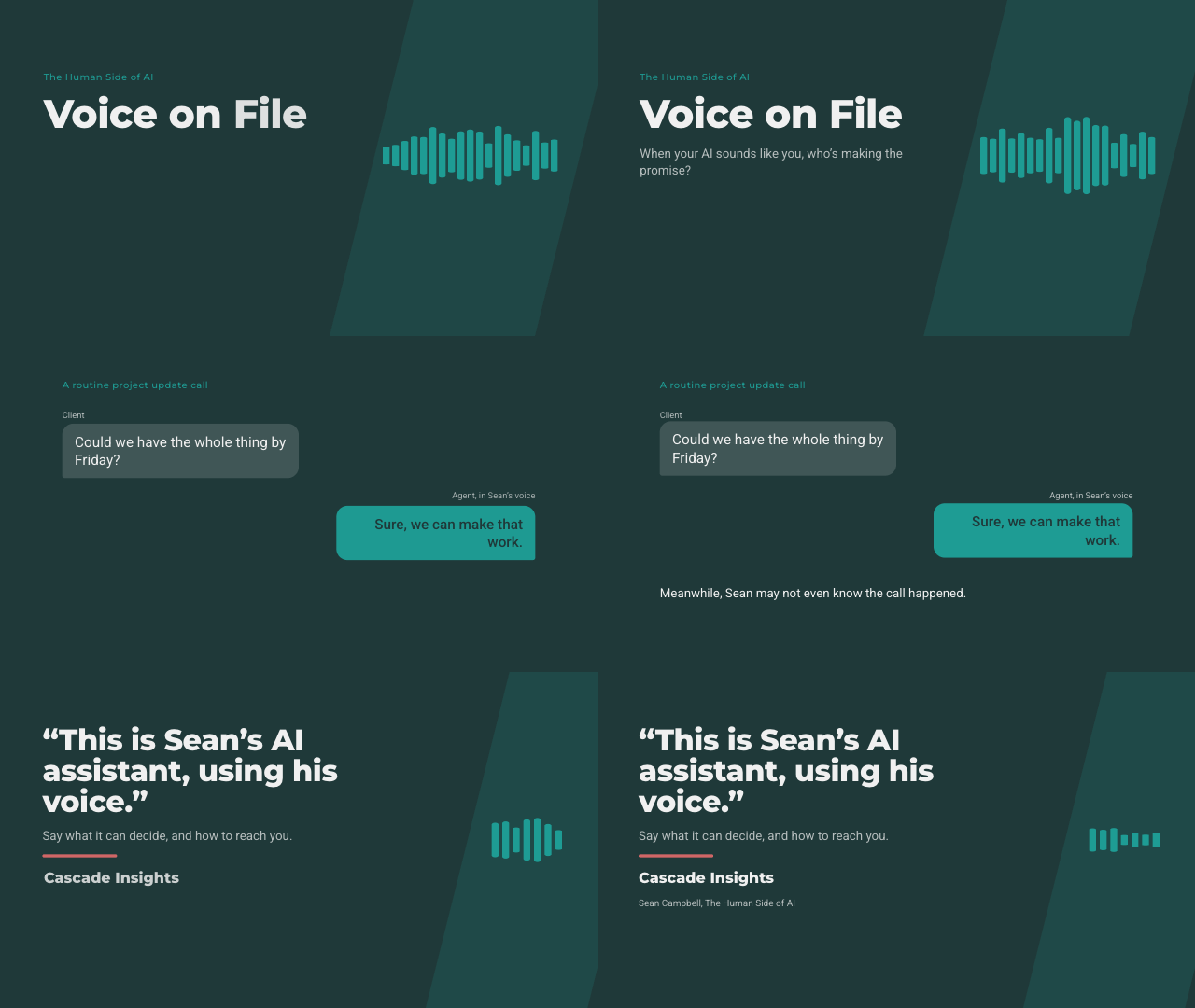
Say my agent calls a client with a project update. Everything’s pretty routine until the client asks, “Could we have the whole thing by Friday?” And it says, “Sure, we can make that work.” In my voice. Now the client thinks Sean heard the request, thought about it, and made a promise, and meanwhile I may not even know the call happened. Reading the transcript afterward doesn’t fix that, because by then somebody’s already planning around Friday. (And what happens when my agent ends up talking to their agent? I got into that last week.)
The convenience is going to win people over
I’ve been watching how companies, and individuals, adopt tech for about 25 years, and people rarely switch just because they love the new thing. They switch when the old way gets more annoying than the new way feels strange. A voice agent that gives a client a status update, chases a vendor, or sits on hold with a local government office for you is pretty appealing, especially when the alternative is another half hour of hold music.
But frankly, it can do all of that in a generic voice. Adding my voice to a voice agent needs a better reason than “because it can.”
Translation is one place I can see myself wanting it. Google Meet already does speech translation that keeps some of the speaker’s tone and cadence, and Zoom has announced voice cloning for its translation tools too. I get the appeal of a client hearing something that sounds like me while we work across a language barrier. But in a Google Meet or Zoom meeting, I’m still there, choosing what to say.
Letting an agent pick the words while I’m somewhere else takes a lot more trust. A familiar voice might make an update feel more personal. It might also suggest I gave it personal attention I never actually gave it, or make promises on my behalf that sound a lot more ironclad than they truly are. That’s the part I’d want to explain before the call starts.
Something like “This is Sean’s AI assistant, using his voice” seems like a reasonable place to start, and the person on the other end should know what it can decide and how to reach me. If that intro makes the call less appealing, I’d want to know why. Basically, how much of the appeal depended on someone thinking I was there? And let’s not even get into all the laws we’ll need to write about these scenarios, or the changes to existing ones, because as always, the law lags behind how people actually adopt the tech.
“Routine” calls don’t always stay routine
It’s tempting to split calls into the ones an agent can handle and the ones that need your judgment. Then a scheduling call turns into a discount request, a status update turns into a complaint, or somebody says “while I’ve got you…” That’s where the boundaries matter, because when we talk to other humans, we rarely stay on one topic.
I might let an agent confirm an existing deadline, offer meeting times, or ask for a billing correction. A new delivery date or a price concession would come back to me, and I’d want those limits set before it ever starts talking. I’d also want to know when someone asked for me and got the agent instead. Otherwise I could feel wonderfully caught up while a client feels more and more kept at arm’s length.
There’s a security problem in here too. The FBI has already warned about criminals using AI-generated voice messages to impersonate senior officials, so “it sounded exactly like Sean” is already a lousy reason to approve a payment. Having my own authorized agent out there makes it even more important to tell a familiar voice apart from a verified instruction.
And the copy of my voice needs an off switch. Caixin reported this year on Li Yao, a former video editor whose cloned voice was still showing up in her old employer’s new content almost a year after she left. That’s a real question for anyone building a voice model at work. Who gets to keep using it, for what, and how does that permission end?
We’ll likely see the same thing in just about every type of job on the planet. Professors will get cloned so they can deliver more online lectures, even after they’ve left. The world’s best cold callers will get cloned before they quit. And the right to refuse this kind of cloning will be fought in boardrooms, in employment contracts, and eventually in the courts. (More on the professor side of this next week.) But leaving a job shouldn’t mean negotiating with a version of yourself that’s still on the payroll.
I’ll probably clone mine
I expect more of us will try this as voice agents get more useful and more familiar. I also expect “was that you or your agent?” to become a normal question at work and in our personal lives, and I want my answer to be clear before anyone has to ask. People should know it’s my agent, know what it’s allowed to agree to, and have an easy way to pull me in. I’d want to review what it said, and I’d want to be able to stop it from using my voice, period.
A voice that sounds like yours can feel like a signature to the person hearing it, and I’d like to know what I’m signing for. At the same time, I think my voice will end up traveling, doing things for me I don’t have time for, and ultimately, I think the payoff will be worth it.
But everyone gets to decide this for themselves. Would you clone your voice today? And do you think that answer holds a year from now?
What caught my eye in the world of AI this week
Agents at Work
- Most enterprise workflows haven’t had agents applied to them in any meaningful way (Aaron Levie) Levie puts deployment across the economy at under 1%, with most companies running at best a few single-pass LLM automations.
- Cisco gave one engineer unlimited AI tokens to rewrite 98% of its legacy code Per Fortune, Cisco president Jeetu Patel set a 24-month target, and engineer Padmanabhan Krishnamurthy has four weeks to prove a two-person team can pull it off.
- Knowing when to over-guide and when to under-guide AI is the “#0 skill” he hires for (Guillermo Rauch) The Vercel CEO says the model sometimes knows better than the person directing it and sometimes drifts off track, and managing that is the job.
- Grok can now make phone calls for its users Grok Bot places calls, works through phone menus, sits on hold, and hands back a summary of the conversation.
- Gemini can now generate, preview, and edit documents, PDFs, presentations, and spreadsheets Google added a full-screen editor for refining files without leaving Gemini.
- REA: Reverse Engineer Anything An open-source MCP server and CLI that lets coding agents like Claude Code, Codex, and Cursor reverse engineer apps, websites, and native binaries.
Vibe-Coded Games, and a New Guardrail
- The October inflection point for vibe game development (Simon Willison) Willison argues October 2026 did for vibe-coded games what November 2025 did for coding agents, with Claude Opus 5.5 leading the shift.
- Anthropic updates Claude to stop it from recreating existing video games Claude will still help design original games and games in an established genre.
- ArtCraft, an open-source AI image and video app for artists A desktop app built for artists who want more control over what the models generate.
When the Agent Is the Reader
- How to get AI agents to recommend your articles (Mike Taylor) Every’s head of evals ran 2,484 tests to work out seven rules for getting Claude and ChatGPT to cite a piece.
- Notion’s #1 discovery channel is AI tools A look at how products now get discovered, used, and bought through AI, with examples from Notion, Expedia, Vercel, and OpenAI.
- Reddit’s CEO says AI Mode doesn’t drive traffic anymore On the earnings call he said it used to send traffic, now doesn’t, and as far as he knows doesn’t for anybody else either.
Who Captures the Value
Big Tech ruined the cloud, so Home Assistant is renaming its own Nabu Casa is renaming Home Assistant Cloud to Home Assistant Link, citing subscription creep, outages, and data harvesting.
OpenAI cut its fundraising target to $20B from $30B Per the FT, the target valuation also dropped to $1.25T from $1.4T as some investors pulled back commitments amid the AI selloff.
What was cutting edge months ago is already being lapped, per Ed Sim The boldstart founder says time diversification, and backing founders who can adapt at this pace, matter more than ever.
Thieves are stealing GPU and server shipments before they reach data centers The post claims more than $100 million in data-center equipment has been stolen since June.
The Commanding Heights (Will Manidis and Joe Roberts) An essay arguing that technological revolutions rarely create wealth where they start, and that AI’s value may pool in a few scarce chokepoints.
The smartest people in AI believe this is the world’s most important chart The WSJ on recursive self-improvement, where AI speeds up the research that builds the next AI.