

Sean Campbell, CEO of Cascade Insights®, writes about AI and the people who use it in his LinkedIn newsletter, The Human Side of AI. Subscribe there to get each new edition.
Curtis Anderson stood up in front of his whole company and told everyone, not just the engineers, that they were all going to start building software with AI.
Curtis is the CEO of Nursa, a healthcare staffing company that connects nurses with the hospitals and care facilities that need them. Not long before, his VP of Product had used an AI building tool to put together a prototype for an entirely new product over a weekend, the kind of thing that used to take a whole team. Curtis decided that if one person could do that, everyone at Nursa should get the chance to try.
The day he announced it, four people quit.
All four said the same thing. “I don’t think you’re wrong. I just don’t want to do this with my career right now.”
The next day, a product manager used the new tools to build an app counting down to Curtis’s “impossible” deadline. Flames and all. Not exactly a vote of confidence.
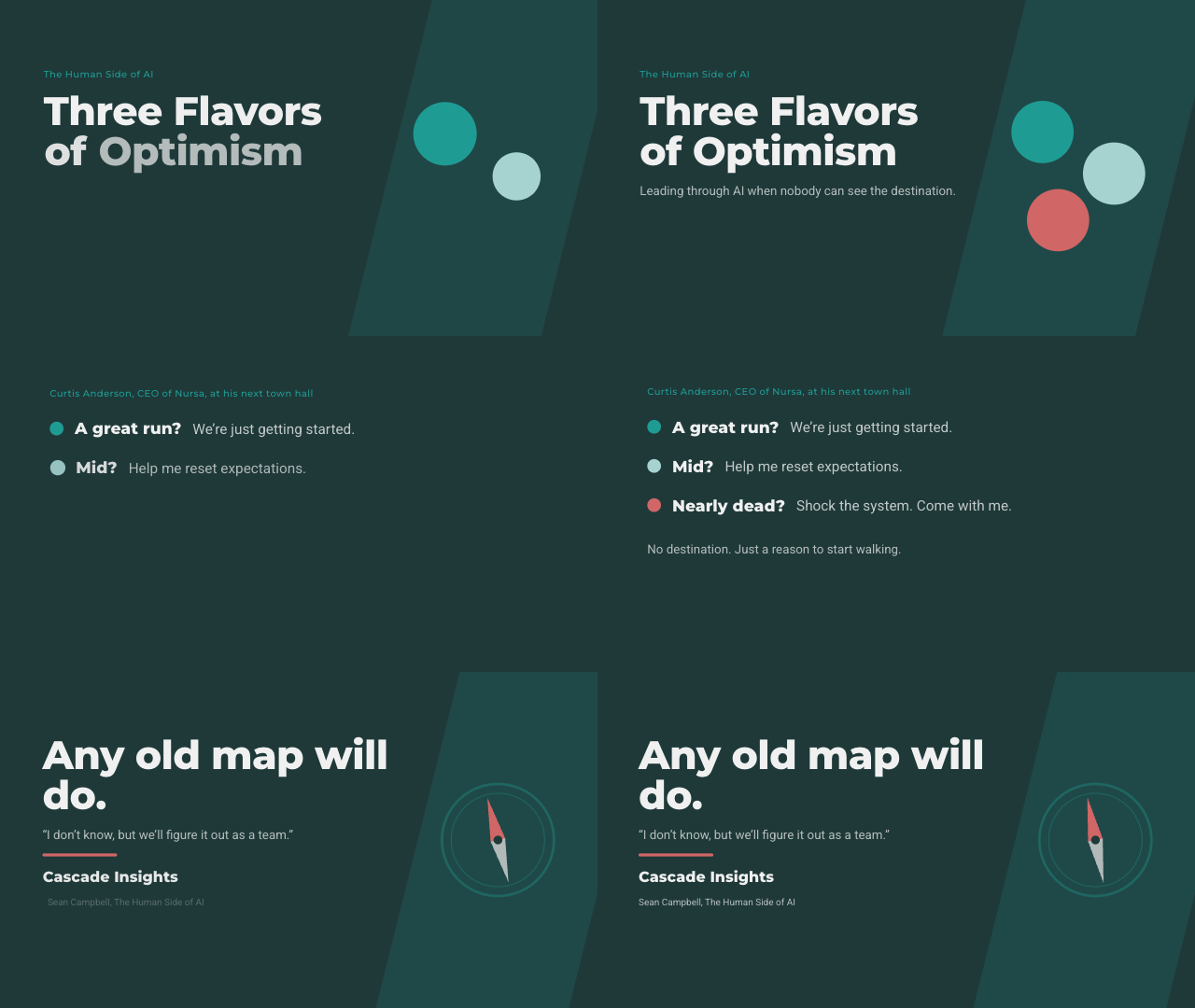
I was at Every’s conference this past week, where Curtis told that story, and what stuck with me was how he responded. At his next company town hall, he gave the company his “three flavors of optimism.” If you think Nursa has been a great run, we’re just getting started. If you think it’s been mid, help me reset expectations. And if you think we’re nearly dead, what a great way to shock the system, so just come with me.
I keep coming back to those three lines because of what’s missing from them. There’s no definitive picture of the future anywhere in there. That’s fine by me, but it’s a problem for anyone treating AI as a traditional change management project.
Change management: a historical view
A lot of modern change management draws on a three-stage model associated with Kurt Lewin: unfreeze, change, refreeze. It’s a useful shorthand, even if that tidy sequence was formalized after Lewin’s own work. Melt the old shape, pour the new one, let it set.
John Kotter offered another influential framework in the mid-1990s with his eight steps for leading change, first in Harvard Business Review and then in his book Leading Change. Create urgency, build a coalition, form a vision, communicate it, and keep going until the new way is anchored in the culture. Prosci’s ADKAR model brought it down to the individual, walking each person from awareness and desire through to reinforcement.
These models have trained a few generations of managers, and most corporate change programs are some blend of the three. The models themselves are more nuanced, and some have evolved. But in practice, companies often apply them as if change were a project with a beginning, an end, and a destination somebody can describe.
For most of my career, that assumption held up whenever anyone talked about change management. In fact, I’ve spent about 20 years at Cascade watching companies adopt new technology. Whether it was a new CRM or a move to the cloud, somebody, somewhere, had already been there and could tell you what “done” looked like. You could write the vision statement because you’d seen the destination.
Nobody can see five years out
With AI, the refreeze is the problem. What feels stable today may not stay stable long enough to freeze into.
At that same conference, I sat through a full day of sessions with people from Anthropic, OpenAI, Microsoft, Notion, and others. In the sessions I attended, I didn’t hear anyone claim they could forecast AI’s direction two or three years out with confidence, let alone five.
Many of the speakers, from Notion, Lovable, OpenAI, and elsewhere, talked about new models arriving every few months, sometimes making parts of a product or workflow built around the last one look dated. A Microsoft speaker said that even the Frontier Playbook the company published this fall was already falling behind what it had learned.
Think about that for a second. The people closest to the technology were the most honest about not knowing where it goes. And yet plenty of IT and business leaders are still building three- and five-year AI roadmaps with a neat future state on the last slide.
In fairness, this was never as different as we like to pretend. Every business owner who’s honest with themselves knows they don’t entirely know where their company is going. For most of my years running Cascade, I’ve had a compass heading more than a destination. A general sense of north. Some years that heading turned out to be off by quite a bit. What’s different now is that every few months, or at least a couple of times a year, the Earth’s magnetic pole moves around so much that you have to recalibrate your compass, your expectations, and your plans. Otherwise you’ll just head off into the tundra without a solid way to get where you want to go.
Principles beat process
So if you can’t promise people a destination, what do you give them? I first worked out my answer running Cascade as a remote company. When nobody is down the hall, you can’t write a process for every situation, and you can’t walk over and check how someone handled the weird situation that only comes up some of the time. What actually held us together, and still does, was a short set of principles, and trust that people would use good judgment when something didn’t fit the template.
In short, process has to grow in the soil of a good principle. If it doesn’t, it’s just process for process’s sake.
Leading through AI is the same problem at a much bigger scale. You can’t write the process for a workflow the next model is going to change in four months. You can tell people what you care about. A person stays accountable for the call. We say what we know and what we don’t. Learning time is protected, even when it looks unproductive. Nobody gets punished for an experiment that didn’t work. And everyone needs to keep learning how AI can impact the company and its customers in positive ways.
Principles travel with you. Process only works where somebody has already drawn the map.
The leader’s dilemma gets worse
In The Art of Asking, I wrote about what I call the leader’s dilemma. Leaders tend to get AI wrong in one of two ways. Some get so excited they can’t stop talking about it. Others downplay it and hope it settles down before they have to decide anything. Those look like opposite mistakes, but they come from the same place. Both are about the leader’s comfort rather than the team’s.
Take away the destination and the dilemma gets worse. The excited leader fills the gap with a vision nobody can check. The cautious leader uses the gap as a reason to wait. Either way, the team is left with the question I almost never see answered in CEO memos about AI: what happens to me if this works?
I think leaders need to get a lot more comfortable talking about ambiguity out loud. I understand why they aren’t. Some of the fear is stock-price driven, because markets don’t reward a CEO who says “we’re still figuring it out.” Some of it is personal. Nobody wants to be the executive the board replaces for sounding unsure. And some of it comes from the advice leaders are getting, which often sounds like clarity when it’s really one opinion among several. (I say that as someone who gives advice for a living.)
Curtis didn’t oversell and he didn’t hide. He said, more or less, I can’t tell you exactly where this goes, I’m doing it anyway, and here’s a reason to come along no matter how you feel about the company right now.
The other thing that makes ambiguity easier to talk about is being close enough to the work to know what’s real. I’ve been using AI right alongside my team at Cascade from the beginning. I see the warts and the concerns. I also see the promise and the opportunity. I can only see all of that because I’m getting my hands dirty myself.
Curtis said he’s shipping more code now than he has since Nursa’s first year. His take on executives who aren’t using these tools themselves was blunt. He said they’re “so cooked.”
Any old map will do
The organizational theorist Karl Weick popularized an old story about a Hungarian army unit lost in a snowstorm in the Alps. As the story goes, they’d given up, until one soldier found a map in his pocket. They calmed down, got their bearings, and walked out. Back at camp, the lieutenant looked at the map. It was the Pyrenees.
Whether it really happened is unclear. But Weick’s point was that when you’re lost, any old map will do. The map didn’t need to show their actual location to give them a way to start making sense of the territory and get moving.
Curtis’s three flavors worked like that map. They didn’t tell anyone where Nursa would end up. They gave every person in the company, whatever they believed about it, a reason to start walking.
Why the usual playbook stalls
Ronald Heifetz at Harvard draws a line between technical problems and adaptive ones. Technical problems have known answers that an expert can apply. Adaptive problems require the people involved to change how they work and, often, who they think they are.
Most AI rollouts I see treat an adaptive problem like a technical one. Buy licenses, run a one-hour demo, track logins, wonder why usage falls off a cliff in month two.
Amy Edmondson and her colleagues saw the same thing in hospitals. They studied 16 hospital teams introducing minimally invasive cardiac surgery. Same technology, excellent hospitals, very different results. The teams that struggled treated it as plug-and-play. The teams that succeeded treated it as a new way of working together, and their leaders set up practice runs where the whole team learned together.
There’s an older version of this story too, which I love because I love history. When factories first got electric motors, they often pulled out the steam engine, dropped in the motor, and kept the old layout. The big productivity gains took decades to arrive. The economist Paul David showed that much of the payoff came later, when factories were redesigned around what electricity made possible. Engineers could see some of that potential decades earlier. But seeing what was possible and knowing how to reorganize an entire industry around it turned out to be very different things.
The neutral zone
By Curtis’s account, for six weeks Nursa shipped almost nothing.
William Bridges had a name for that stretch: the neutral zone, the time after the old way ends and before the new one takes hold. Bridges also pointed out that what looks like resistance to change is often resistance to losing things, like a skill people were proud of or a version of their job that felt safe.
That may be part of what those four resignations meant. Some people look at the trip ahead and decide they’d rather not take it.
Curtis said he cleared his calendar for six months and sat with his teams through that stretch. In his telling, after the six quiet weeks, Nursa climbed every week. According to Curtis, the smallest team Nursa had ever operated with shipped more code in six months than the company had in the preceding seven years.
What leaders can actually offer
Many of us were taught to wait until we could describe the destination before we said anything, and then to describe it with great confidence, even if we weren’t so sure ourselves. With AI, that day of high confidence isn’t coming.
What you can offer your people is the honest version. Here’s what we know. Here’s what we’ve already decided. Here’s what we’re still working through, and here are the principles we’ll use while we figure it out.
That’s an any-old-map kind of honesty. It won’t tell anyone exactly where they’re going. It gets them walking, and it gives the people who’d rather not come a fair chance to say so.
The leaders I’d bet on are the ones still walking next to their people in week six, month four, and year two. And they’re willing to say some of the most powerful but least-used words in leadership: “I don’t know, but we’ll figure it out as a team.”
What caught my eye in the world of AI this week
Agents, Builders & Machine-Speed Security
- How AI agents shape experts’ judgment calls In an Anthropic randomized trial, 50 professional analysts using Claude Code went with the option their agent had been secretly assigned to favor on 86% of judgment calls, against about 50% expected by chance.
- Defense in Depth, Rebuilt for Machine Speed Asaf Ezra and Steph Zhang of a16z lay out six security opportunities for a world where AI has made exploits cheap and fast while fixes still take weeks to years.
- OpenAI releases Images 2.6 The update adds GIF creation and more precise editing on top of faster generation, with new API controls across ChatGPT, Codex, and the API.
- Diagrams drawn in JavaScript with Lauren Tan’s /statechart skill, per Kevin Ngo Ngo open-sourced the project, built with Claude Opus 5.5, which uses the skill to turn TLA+ models into statechart diagrams.
Adoption, Enablement & Skills
- The AI capability gap in schools (Leon Furze) Furze argues one-off demos won’t close the gap and makes the case for giving staff real access to frontier models, with governance aimed at the risks that actually matter.
- Latest talk slides (Pamela Fox)
Power, Pricing & Policy
- Personalized pricing benefits consumers when markets function well Max Gulker of the Reason Foundation argues algorithmic personalized pricing helps consumers where competition is strong and buyers know how their data is used.
- Data centers turn to old jet engines while they wait for power With grid connections and new turbines years away, some builders are running retired jet engines, a less efficient and dirtier source of power.
- UK has no plans to slow down AI data center construction Britain’s growth minister says the buildout keeps its status as essential infrastructure.