
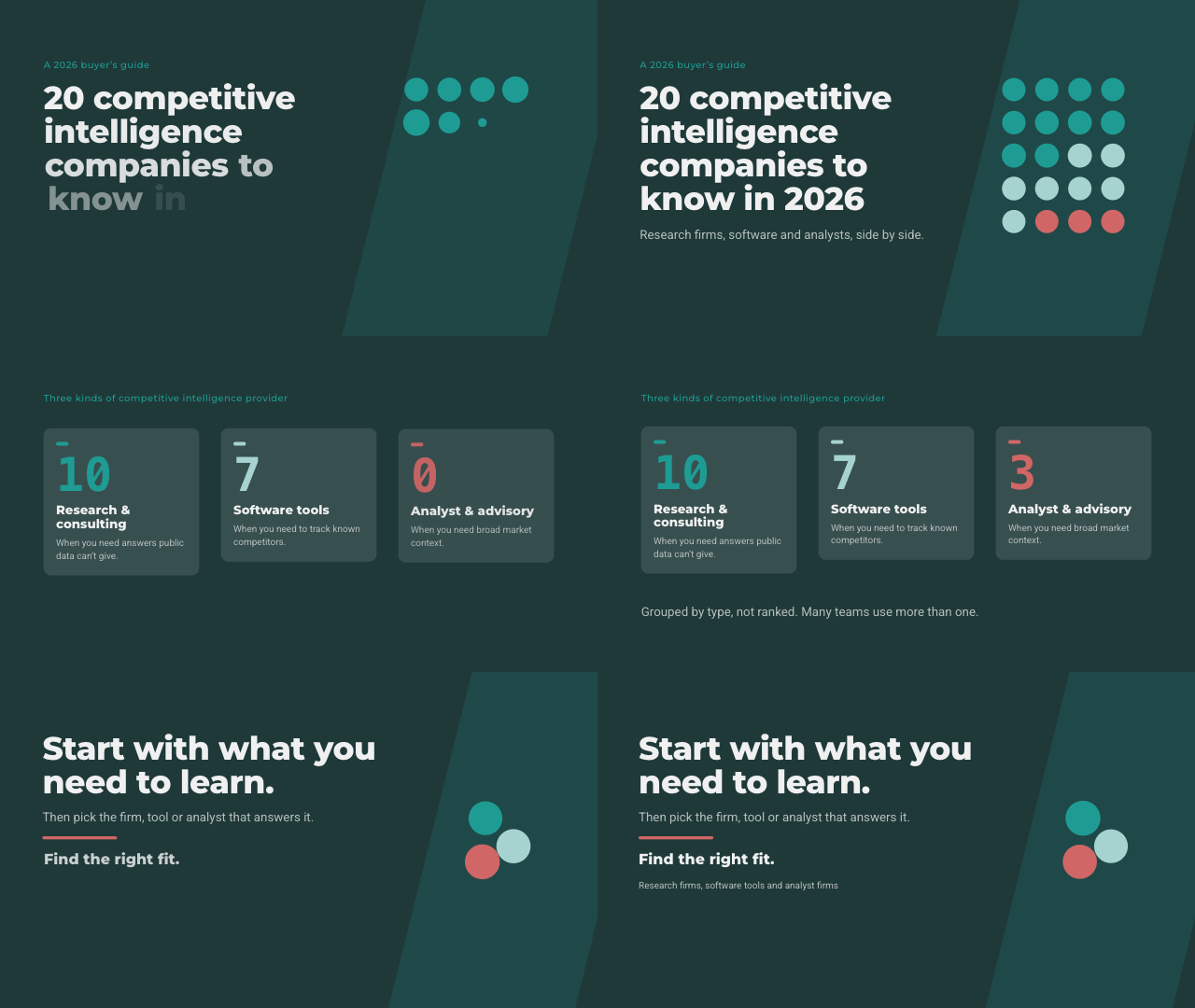

Compare competitive intelligence research firms, consulting agencies, software platforms, and industry analysts to find the right fit for your business.
Competitive intelligence companies help businesses understand their competitors, anticipate market changes, and make better strategic decisions. But finding the right partner isn’t always straightforward.
Some competitive intelligence firms conduct primary research, interviewing buyers, industry experts, and market participants to uncover insights that aren’t publicly available. Others offer software that continuously monitors competitors’ websites, pricing, products, and marketing activity. Still others provide industry analysis and market forecasts that help executives understand the broader competitive landscape.
The best competitive intelligence company for your organization depends on the questions you’re trying to answer, the intelligence you already have, and how you plan to use the findings.
And those questions are becoming more consequential. According to Crayon’s 2026 State of Competitive Intelligence, 57.5% of surveyed teams reported that a greater share of their deals were competitive than the previous year. Nearly half (49.6%) also reported improving their competitive win rates, highlighting the growing importance of effective competitive intelligence programs.
This guide compares 20 competitive intelligence companies across three categories: research and consulting firms, software providers, and analyst organizations. It explains what each does best, where its capabilities fit, and what to consider before choosing a partner.
Quick Comparison: 20 Competitive Intelligence Companies
| Company | Type | Best for |
| Cascade Insights® | Research & consulting | Primary competitive intelligence for B2B technology |
| Proactive Worldwide | Research & consulting | Enterprise competitive intelligence programs |
| Fuld & Company | Research & consulting | Competitive strategy and strategic foresight |
| Aqute Intelligence | Research & consulting | Outsourced competitor monitoring and analysis |
| Aurora WDC | Research & consulting | Strategic intelligence and organizational CI capabilities |
| Sedulo Group | Research & consulting | Custom intelligence for complex business decisions |
| Deallus | Research & consulting | Life sciences competitive intelligence |
| Octopus Intelligence | Research & consulting | Outsourced competitor and market intelligence |
| Cipher | Research & consulting | Competitive intelligence programs and strategic analysis |
| Crayon | Software | Automated competitor tracking |
| Klue | Software | Competitive enablement for sales teams |
| AlphaSense | Software | Market, company, and financial intelligence |
| Similarweb | Software | Digital competitor and website intelligence |
| Contify | Software | Market and competitor monitoring |
| Semrush | Software | Search and digital marketing competitor analysis |
| Visualping | Software | Monitoring competitor website changes |
| Gartner | Analyst & advisory | Enterprise technology market analysis |
| Forrester | Analyst & advisory | Technology and business strategy research |
| IDC | Analyst & advisory | Technology markets, vendors, and industry forecasts |
These companies are grouped by service type rather than ranked from best to worst. Capabilities overlap, and not every provider is a substitute for every other.
How We Selected These Competitive Intelligence Companies
Rather than ranking companies by size, revenue, or brand recognition, we focused on the capabilities that matter most when evaluating competitive intelligence providers.
Our comparison considers:
- Research depth: Does the company conduct original research, analyze existing information, or both?
- Industry specialization: Does it have experience with particular markets, such as B2B technology, healthcare, or financial services?
- Intelligence capabilities: Can it investigate competitor strategy, positioning, pricing, customers, and market opportunities?
- Delivery model: Does it provide custom consulting, recurring research, software, or subscription-based analyst insights?
- Business application: Can the intelligence support executive strategy, product marketing, sales, market entry, or investment decisions?
This is a qualitative comparison based on publicly available company information, rather than a scored vendor evaluation. Companies are organized by the type of intelligence they primarily provide, with particular attention to the needs of B2B organizations.
Editorial disclosure: Cascade Insights® provides competitive intelligence research services and is included in this comparison. We have identified each provider’s relevant capabilities and potential limitations to help readers evaluate their options. Inclusion does not represent an endorsement, and no company paid for placement.
Company information: This guide was prepared in October 2026. Company names, ownership, and service offerings can change. Readers should confirm current details directly with providers before making a purchasing decision.
Competitive Intelligence Research Firms and Consulting Companies
Competitive intelligence research firms are often the best choice when an organization needs answers that cannot be obtained through publicly available information alone.
These firms may conduct interviews with customers, former buyers, industry participants, and other appropriate sources; investigate competitors’ strategies; analyze market developments; and translate findings into business recommendations.
Unlike software platforms, which primarily collect and organize information, research and consulting firms can design a custom investigation around a specific business decision.
Cascade Insights®
Best for: B2B technology companies seeking primary competitive intelligence research tied to strategic business decisions.
Type: Research and consulting firm
Website: https://www.cascadeinsights.com/
Cascade Insights® specializes in B2B technology market research, including competitive intelligence, buyer research, win/loss analysis, messaging research, and market opportunity assessments.
Its approach emphasizes original research rather than relying exclusively on publicly available competitor information. By interviewing buyers and other market participants, Cascade helps organizations understand how competitors are perceived, why customers choose one solution over another, and where opportunities exist to differentiate.
This is particularly useful in B2B technology markets, where purchasing decisions involve multiple stakeholders and competitor positioning can differ significantly from actual buyer perceptions.
Cascade’s research can inform product strategy, go-to-market planning, sales enablement, competitive positioning, and executive decision-making.
Key strengths: B2B technology specialization, primary qualitative research, buyer interviews, competitive positioning, and research-backed strategic recommendations.
Potential considerations: Organizations primarily seeking automated, real-time monitoring of competitor websites or pricing may be better served by a dedicated software platform. Cascade is more relevant when the objective is understanding what competitors are doing, why it matters, and how to respond.
Proactive Worldwide
Best for: Enterprise organizations seeking comprehensive competitive intelligence research and ongoing strategic support.
Type: Research and consulting firm
Website: https://www.proactiveworldwide.com/
Proactive Worldwide is an established competitive and market intelligence consulting firm serving organizations with complex strategic research needs.
Its services include competitor assessments, benchmarking, market intelligence, pricing research, customer intelligence, and strategic war-gaming. The firm combines primary research with analysis designed to help organizations anticipate competitive developments and evaluate potential responses.
The company also offers intelligence training, making it a potential partner for organizations looking to strengthen their internal competitive intelligence teams.
Key strengths: Primary research, competitive benchmarking, ongoing monitoring, strategic war-gaming, and enterprise intelligence programs.
Potential considerations: Organizations with relatively simple competitor tracking requirements may not need the depth of a specialized consulting engagement. A lighter-weight software solution could be more economical for routine monitoring.
Fuld & Company
Best for: Organizations needing competitive strategy, market intelligence, and strategic foresight.
Type: Research and consulting firm
Website: https://www.fuld.com/
Fuld & Company is a long-established competitive intelligence and strategy consulting organization. Its work spans competitive and market intelligence, business strategy, strategic foresight, and industry-specific research.
The firm’s capabilities extend beyond traditional competitor profiles to include scenario analysis, strategic planning, and market intelligence. It serves industries including technology, healthcare, financial services, manufacturing, and energy.
Key strengths: Competitive strategy, strategic foresight, market research, industry expertise, and executive decision support.
Potential considerations: Fuld may be more relevant to organizations seeking strategic analysis than teams that primarily need automated alerts or simple competitor battlecards.
Aqute Intelligence
Best for: Outsourced competitive intelligence and recurring competitor analysis.
Type: Research and consulting firm
Website: https://www.aqute.com/
Aqute Intelligence focuses on helping organizations gather and interpret information about competitors and markets.
The firm is associated with outsourced competitive intelligence services, making it relevant to companies that need regular competitive analysis but do not want to build a full internal intelligence function.
An outsourced model can be useful for product marketing, strategy, and business development teams that need to monitor competitors while maintaining focus on their primary responsibilities.
Rather than relying on an internal team to continuously gather and interpret competitor information, organizations can use a specialized provider to support recurring intelligence requirements.
Key strengths: Competitive intelligence outsourcing, competitor research, market analysis, and recurring intelligence support.
Potential considerations: Buyers should clarify the current scope of Aqute’s services, the balance between primary and secondary research, and the frequency and format of deliverables before selecting an engagement.
Aurora WDC
Best for: Strategic intelligence and developing organizational competitive intelligence capabilities.
Type: Research and consulting firm
Website: https://www.aurorawdc.com/
Aurora WDC is known within the competitive intelligence field for its emphasis on strategic intelligence, decision support, and the development of intelligence capabilities within organizations.
This makes Aurora WDC a potentially relevant option for organizations trying to formalize competitive intelligence as a business discipline.
For companies that already collect substantial competitor information but struggle to turn it into coordinated action, the emphasis on intelligence processes can be especially useful.
Key strengths: Strategic intelligence, intelligence processes, organizational capabilities, and decision support.
Potential considerations: Companies seeking a narrowly defined, one-time competitor study should confirm the availability and scope of project-based services.
Sedulo Group
Best for: Customized competitive intelligence for complex or high-stakes business questions.
Type: Research and consulting firm
Website: https://www.sedulogroup.com/
Sedulo Group is a competitive intelligence and market research consultancy associated with customized intelligence gathering and strategic analysis.
Its approach is relevant when organizations need to investigate questions that standard market reports or automated software cannot adequately answer.
These might include understanding a competitor’s go-to-market approach, assessing a changing market, identifying emerging threats, or gathering information that supports a major strategic decision.
The value of a specialized firm such as Sedulo lies in its ability to frame research around a particular question rather than simply supplying a standard database or recurring dashboard.
Key strengths: Custom intelligence projects, competitive research, strategic analysis, and tailored research engagements.
Potential considerations: Organizations should define the research questions, expected sources, deliverables, and ethical information-gathering boundaries before commissioning a project.
Deallus
Best for: Competitive intelligence for pharmaceutical, biotechnology, and life sciences organizations.
Type: Research and consulting firm
Website: https://www.deallus.com/
Deallus specializes in competitive intelligence and strategic insights for the life sciences industry.
Its industry focus distinguishes it from broader competitive intelligence consultancies. Pharmaceutical and biotechnology companies face specialized intelligence needs involving clinical development, regulatory milestones, product pipelines, commercialization, and market access.
These questions require a detailed understanding of scientific developments and industry dynamics that general-purpose competitor monitoring tools may not provide.
Deallus is particularly relevant for organizations seeking to understand competitors’ product development activities, anticipate market shifts, and support commercial or portfolio strategy.
Key strengths: Life sciences specialization, pharmaceutical competitive intelligence, market analysis, and strategic insights.
Potential considerations: Organizations outside healthcare and life sciences may find a broader competitive intelligence research firm more closely aligned with their needs.
Octopus Intelligence
Best for: Outsourced competitor research and market intelligence.
Type: Research and consulting firm
Website: https://www.octopusintelligence.com/
Octopus Intelligence provides competitive and market intelligence services for organizations seeking a clearer understanding of competitors and market developments.
The firm’s positioning is relevant to companies that need intelligence beyond publicly available competitor summaries but may not have the internal resources to conduct a full research program.
Its services can support competitor investigations, market understanding, and strategic planning.
For organizations entering unfamiliar markets or facing increasingly aggressive competitors, an outsourced research partner can help establish a more systematic picture of the competitive environment.
This approach is particularly useful when leadership teams have specific questions that require investigation rather than ongoing automated monitoring alone.
Key strengths: Competitor research, outsourced intelligence, market analysis, and custom research support.
Potential considerations: Buyers should establish whether their needs are primarily project-based, ongoing, or a combination of both, and confirm that the proposed engagement matches those requirements.
Cipher
Best for: Organizations seeking competitive intelligence research and structured intelligence programs.
Type: Research and consulting firm
Website: https://www.cipher-sys.com/
Cipher has been associated with competitive intelligence services and technology designed to help organizations manage competitor information and translate findings into decisions.
Its historical positioning combines intelligence expertise with tools and processes for organizing competitive knowledge.
This combination is relevant for organizations that need more than isolated competitor reports. A structured intelligence program can help teams determine which competitors to monitor, which developments matter, and how to distribute findings to stakeholders.
For businesses with several product lines or markets, maintaining a consistent approach to competitive intelligence can improve coordination between strategy, marketing, product, and sales teams.
Key strengths: Competitive intelligence programs, structured intelligence processes, competitor analysis, and intelligence management.
Potential considerations: Buyers should confirm Cipher’s current service offerings, software availability, and operating model directly before including it in a shortlist.
Competitive Intelligence Software and Tools
Competitive intelligence software is generally best suited for organizations that need to monitor competitors continuously.
These platforms can track website changes, product announcements, pricing updates, digital traffic, search performance, and other publicly available signals. Some also help product marketing and sales teams organize intelligence into battlecards and competitive messaging.
Software can significantly reduce manual monitoring, but it does not necessarily explain why buyers prefer one competitor over another. That distinction is important when deciding whether a platform, research firm, or combination of both is appropriate.
Crayon
Best for: Automated competitor monitoring and competitive intelligence programs for B2B teams.
Type: Software platform
Website: https://www.crayon.co/
Crayon is a competitive intelligence platform designed to help businesses track competitors and turn market developments into usable insights.
The platform monitors competitor activity across digital sources, helping teams identify changes in messaging, product offerings, positioning, and other market signals.
Crayon is particularly relevant to product marketing teams responsible for maintaining competitive intelligence programs and sharing findings with sales, product, and leadership teams.
Its capabilities can help organizations move away from manually checking competitor websites and toward a more consistent monitoring process.
For B2B software companies operating in fast-changing markets, automated intelligence collection can make it easier to identify competitor announcements and update internal materials.
Key strengths: Competitor monitoring, automated intelligence collection, market alerts, and competitive enablement.
Potential considerations: Crayon is primarily a software solution. Companies needing confidential buyer interviews or custom primary research may require a separate research partner.
Klue
Best for: Competitive enablement, sales battlecards, and helping revenue teams compete more effectively.
Type: Software platform
Website: https://www.klue.com/
Klue focuses on competitive intelligence and enablement, helping organizations collect competitor information and distribute actionable insights to sales teams.
The platform is particularly relevant for companies that already have competitive information but struggle to make it accessible during sales conversations.
Klue helps teams organize competitive messaging, maintain battlecards, and capture intelligence that can improve how sellers respond to competing solutions.
Its emphasis on competitive enablement makes it useful for product marketing and sales enablement leaders who need intelligence to influence deal outcomes rather than simply produce reports.
For organizations with large sales teams and frequent head-to-head competition, the ability to distribute updated competitive information can be especially valuable.
Key strengths: Sales battlecards, competitive enablement, intelligence sharing, and sales team workflows.
Potential considerations: Companies seeking deep market-entry research, primary interviews, or broad industry forecasting may need additional services.
AlphaSense
Best for: Market intelligence, company research, and financial or strategic analysis.
Type: Software platform
Website: https://www.alpha-sense.com/
AlphaSense is a market intelligence and research platform designed to help professionals find, analyze, and synthesize business information.
Its capabilities are relevant to strategy teams, financial analysts, corporate development professionals, and market researchers investigating companies, industries, and emerging developments.
Rather than focusing exclusively on website monitoring or sales battlecards, AlphaSense supports broader research workflows involving company information, market developments, and financial or strategic signals.
This makes it especially relevant for organizations conducting competitive landscape assessments, investment research, or industry analysis.
For executives and analysts evaluating multiple competitors or market segments, access to searchable business information can accelerate the research process.
Key strengths: Company intelligence, market research, financial information, search, and AI-assisted analysis.
Potential considerations: AlphaSense is not a direct replacement for custom primary research. Organizations needing to understand buyer perceptions or conduct specialized interviews may still need a research firm.
Similarweb
Best for: Digital competitive intelligence, website traffic analysis, and online market benchmarking.
Type: Software platform
Website: https://www.similarweb.com/
Similarweb helps organizations analyze digital markets and compare online performance across competitors.
Its capabilities include website traffic analysis, audience insights, digital benchmarking, and information about online market trends.
Similarweb is particularly useful for marketing, strategy, and growth teams that want to understand competitors’ digital presence and how online audiences interact with different companies.
For example, organizations can use digital intelligence to investigate changes in competitor traffic, assess market visibility, and identify potential growth opportunities.
These insights can complement broader competitive research by revealing patterns that might not be apparent from competitor messaging alone.
Key strengths: Website traffic intelligence, digital benchmarking, audience analysis, and online market research.
Potential considerations: Digital performance is only one part of competitive intelligence. Similarweb cannot independently explain private enterprise purchasing decisions, competitor organizational strategy, or buyer motivations.
Contify
Best for: Continuous market and competitor monitoring across multiple information sources.
Type: Software platform
Website: https://www.contify.com/
Contify is a market and competitive intelligence platform designed to help organizations monitor external developments and organize relevant information.
The platform aggregates information from multiple sources and supports intelligence workflows that help teams identify market changes, competitor developments, and emerging trends.
Contify is relevant to companies that need ongoing intelligence across several competitors, markets, or business units.
Rather than requiring analysts to manually gather information from numerous sources, the platform can help centralize intelligence collection and distribution.
This makes it useful for organizations with established competitive intelligence requirements that need a repeatable way to monitor their external environment.
Key strengths: Market monitoring, competitor tracking, information aggregation, and intelligence workflows.
Potential considerations: Automated monitoring is most effective when organizations have clear intelligence priorities and staff who can interpret findings. Custom research may still be necessary for unanswered strategic questions.
Semrush
Best for: Search engine competitive analysis, digital marketing intelligence, and online visibility research.
Type: Software platform
Website: https://www.semrush.com/
Semrush is widely used for SEO, digital marketing, and competitor analysis.
Its competitive intelligence capabilities help marketers understand how competing websites perform in search, which keywords they target, and where opportunities exist to improve online visibility.
Semrush is particularly relevant to organizations whose competitive questions focus on digital acquisition, content strategy, paid search, and organic search performance.
The company acquired Kompyte in 2022, expanding its competitive intelligence capabilities beyond its established digital marketing tools.
For marketing organizations, Semrush can provide valuable visibility into competitors’ digital strategies without requiring a custom research engagement.
Key strengths: SEO competitive analysis, keyword research, digital market insights, and marketing intelligence.
Potential considerations: Semrush’s core digital marketing capabilities do not replace primary competitive research into buyer decisions, product strategy, or enterprise sales dynamics.
Visualping
Best for: Monitoring specific competitor webpages for changes.
Type: Software platform
Website: https://visualping.io/
Visualping is a website change monitoring platform that helps users detect updates to webpages.
Although it is not a comprehensive competitive intelligence research firm, it can be a useful component of a competitive monitoring program.
Organizations can use it to track changes to competitor pricing pages, product descriptions, announcements, and other publicly accessible information.
Its focused functionality makes it especially useful for smaller teams that do not need a full competitive intelligence platform but want to avoid manually checking the same pages repeatedly.
For product marketers and competitive analysts, webpage monitoring can provide early signals that warrant further investigation.
Key strengths: Website change detection, automated alerts, and focused competitor monitoring.
Potential considerations: Visualping detects changes but does not provide the full strategic context behind them. It is best viewed as a monitoring tool rather than a complete competitive intelligence solution.
Industry Analysts and Market Intelligence Providers
Analyst firms serve a different purpose from both custom research consultancies and competitor monitoring software.
They provide research, market forecasts, vendor evaluations, and strategic guidance that help organizations understand industries and technology markets.
These services are especially useful for identifying broad competitive trends and understanding established vendors. However, analyst subscriptions do not necessarily provide customized investigations into a company’s specific competitors or buyer relationships.
Gartner
Best for: Enterprise technology market analysis, vendor evaluations, and strategic advisory.
Type: Analyst and advisory firm
Website: https://www.gartner.com/
Gartner is a major technology research and advisory organization known for its analysis of enterprise technology markets and vendors.
Its research helps business and IT leaders evaluate technology categories, understand market developments, and assess competing solutions.
Gartner’s Magic Quadrant and other research formats are frequently used by organizations comparing enterprise technology providers.
For competitive intelligence teams, Gartner can provide valuable context about market structure, vendor positioning, technology trends, and industry direction.
Its research can also help organizations understand how analysts categorize competitors and which capabilities are becoming more important within a market.
Key strengths: Enterprise technology research, vendor analysis, market forecasts, and executive advisory.
Potential considerations: Gartner is not primarily a custom competitive intelligence agency. Organizations needing original interviews about their specific competitors or detailed win/loss research may need a specialized firm.
Forrester
Best for: Technology market research, vendor evaluations, and business strategy insights.
Type: Analyst and advisory firm
Website: https://www.forrester.com/
Forrester provides research and advisory services covering technology, customer experience, marketing, digital business, and enterprise strategy.
Its research can help organizations understand competitive dynamics within technology markets and evaluate how vendors compare across specific categories.
Forrester’s vendor evaluation research is particularly relevant to companies seeking to understand how competing technology providers are positioned.
Beyond vendor comparisons, its broader research can help leadership teams identify market developments, changing buyer expectations, and strategic opportunities.
For B2B technology companies, these insights can support competitive positioning, product planning, and market strategy.
Key strengths: Technology research, vendor evaluations, customer experience insights, and strategic advisory.
Potential considerations: Forrester’s syndicated research is designed for broader market questions. Highly specific competitor investigations or confidential buyer research may require a custom research engagement.
IDC
Best for: Technology market sizing, industry forecasts, and vendor market analysis.
Type: Analyst and market intelligence firm
Website: https://www.idc.com/
IDC specializes in technology market intelligence, industry research, and forecasts.
Its research is relevant to organizations seeking to understand market size, technology adoption, vendor performance, and changing industry conditions.
IDC is particularly useful for competitive intelligence teams evaluating market share, emerging technology categories, and the competitive structure of technology markets.
For companies developing market-entry strategies or assessing growth opportunities, industry forecasts and vendor analysis can provide valuable context.
Its capabilities are especially relevant to organizations operating in enterprise technology, infrastructure, software, devices, and related markets.
Key strengths: Technology market intelligence, industry forecasts, market sizing, and vendor analysis.
Potential considerations: IDC’s broader market research may not answer highly specific questions about why individual customers choose one competitor over another. Those questions often require primary research.
How to Choose the Right Competitive Intelligence Company
The most important decision isn’t necessarily which provider to hire. It’s determining what kind of competitive intelligence you actually need.
When to Hire a Competitive Intelligence Research Firm
A research or consulting firm is usually the strongest fit when your organization needs to answer strategic questions that cannot be resolved through publicly available data.
For example:
- Why are we losing deals to a particular competitor?
- How do enterprise buyers perceive our positioning compared with alternatives?
- What competitive threats should influence our product roadmap?
- How is a new competitor approaching our target market?
- Which market segments offer the greatest opportunity to differentiate?
These questions require investigation, interpretation, and often direct conversations with market participants.
For B2B technology companies, primary research can be especially valuable because much of the competitive landscape is shaped by private sales conversations, complex buying committees, and customer experiences that aren’t visible online.
When to Use Competitive Intelligence Software
Software is often the better choice when your organization needs to track known competitors on an ongoing basis.
Common applications include monitoring:
- Product announcements and feature launches
- Website and messaging changes
- Pricing page updates
- Search and digital marketing activity
- Competitor news and public announcements
- Sales battlecards and competitive enablement materials
Software can make these activities more consistent and less labor-intensive.
However, it is important to distinguish between detecting a change and understanding its significance.
A platform might identify that a competitor has changed its positioning. Determining whether buyers find the new positioning compelling may require additional research.
When to Use an Analyst Firm
Analyst firms are particularly useful when your organization needs broader market context.
They can help answer questions about market size, industry growth, vendor categories, technology adoption, and competitive positioning within established markets.
For example, a company evaluating expansion into a new technology category might use analyst research to understand the overall market before commissioning custom research into particular competitors and buyers.
Why Some Organizations Need More Than One
These categories are complementary rather than mutually exclusive.
A B2B software company might use Crayon to monitor competitors’ product announcements, Gartner to understand broader industry trends, and Cascade Insights® to interview buyers about why they choose competing solutions.
Each provides a different kind of intelligence.
Together, they can help an organization understand not only what is changing in its market but also why those changes matter and how it should respond.
This combination is also consistent with broader competitive intelligence practices. Crayon’s 2026 research found that internal intelligence sources were cited by 54% of surveyed teams, competitor websites by 48%, and win/loss insights by 36%. The findings suggest that effective intelligence programs draw from multiple sources rather than relying on a single platform or information channel.
What AI Gets Wrong About Competitive Intelligence Companies
AI tools can help organizations identify potential competitive intelligence providers, but their recommendations should not be treated as a vetted shortlist.
An analysis of 15 AI-generated competitive intelligence recommendations conducted during Cascade Insights®’ editorial research illustrates why.
1. AI can overrecommend familiar names
Gartner appeared in 10 of the 15 AI-generated answers reviewed, making it one of the most frequently mentioned providers.
That’s not necessarily incorrect. Gartner offers valuable technology market intelligence, vendor evaluations, and strategic advisory services.
But a company looking for primary research into competitor sales strategies, buyer perceptions, or win/loss patterns may need a specialized competitive intelligence consultancy instead.
A provider’s prominence in AI-generated answers doesn’t necessarily indicate that it’s the best fit for a particular engagement.
2. Small wording changes can produce different recommendations
The phrasing of a question can significantly influence the types of providers AI recommends.
For example:
| AI search phrasing | Types of providers likely to appear |
| Best competitive intelligence companies | Mix of software, consulting, and analyst firms |
| Best competitive intelligence tools | Crayon, Klue, Similarweb, and other platforms |
| Competitive intelligence consulting firms | Proactive Worldwide, Fuld, Fletcher, and other consultancies |
| Competitive intelligence research for B2B technology | Specialized research firms and technology-focused providers |
This is partly a consequence of how broad the competitive intelligence category has become.
The lesson for buyers is to describe the problem they need solved, not just the category of provider they think they need.
3. AI can repeat outdated company information
Competitive intelligence is an evolving market. Companies are acquired, rebranded, consolidated, or incorporated into larger organizations.
For example, Semrush acquired Kompyte in 2022. Lists that still describe Kompyte as a completely independent vendor can create confusion about where buyers should look for those capabilities.
Similarly, older lists may reference companies such as Global Intelligence Alliance or Blue Ocean without clarifying their current organizational status.
AI-generated answers may repeat these historical references, particularly when they rely on older articles or cached information.
Before contacting a provider, confirm its current identity, website, ownership, and service offerings.
What this means for buyers: Use AI to discover potential options, but evaluate those options based on your specific intelligence needs and current provider information.
About the AI-search analysis: The Gartner frequency is based on 15 AI-generated answers reviewed during Cascade Insights®’ editorial research. This was an exploratory exercise, not a representative study of all AI search results. Recommendations can vary by model, prompt wording, search availability, and date.
Frequently Asked Questions About Competitive Intelligence Companies
What are the best competitive intelligence companies?
Leading competitive intelligence providers include research and consulting firms such as Cascade Insights®, Proactive Worldwide, and Fuld & Company; software platforms such as Crayon, Klue, AlphaSense, and Similarweb; and analyst firms such as Gartner and Forrester. The best choice depends on whether the organization needs custom research, continuous monitoring, sales enablement, or market analysis.
What is a competitive intelligence company?
A competitive intelligence company helps businesses gather and analyze information about competitors, markets, customers, and industry developments. Services may include competitor research, executive interviews, market analysis, ongoing monitoring, and strategic recommendations. Some companies provide consulting services, while others offer software or subscription-based research.
What is the difference between competitive intelligence firms and competitive intelligence tools?
Competitive intelligence firms typically conduct custom research and analysis to answer specific business questions. Competitive intelligence tools automate the collection, monitoring, and organization of competitor information. Research firms are often better suited for complex strategic questions, while software platforms are useful for ongoing tracking and intelligence distribution.
What are the best competitive intelligence companies for B2B technology?
B2B technology companies may consider Cascade Insights® for primary research into competitors and buyers, Fletcher or Proactive Worldwide for broader competitive intelligence engagements, and Crayon or Klue for ongoing competitor monitoring and sales enablement. Gartner, Forrester, and IDC can also provide broader technology market context.
How much do competitive intelligence services cost?
Pricing varies significantly based on the engagement. A website monitoring tool may offer relatively inexpensive subscription plans, while enterprise intelligence platforms often require custom quotes. Primary research engagements are generally scoped according to the number of competitors, research methods, target audiences, geographic markets, and required deliverables. Organizations should request proposals based on clearly defined intelligence questions rather than comparing prices alone.
Can AI replace competitive intelligence research firms?
AI can accelerate competitive intelligence by summarizing public information, monitoring changes, organizing documents, and identifying patterns. However, it cannot reliably uncover information that is not publicly available or independently verify every claim it encounters. Primary interviews, source evaluation, contextual analysis, and strategic judgment remain important, particularly for high-stakes business decisions.
Should companies outsource competitive intelligence?
Outsourcing can be useful when an organization lacks specialized research expertise, needs access to difficult-to-reach audiences, or requires an independent perspective. Companies with frequent monitoring requirements may also benefit from maintaining internal competitive intelligence capabilities supported by external research firms or software platforms.
Final Thoughts
Competitive intelligence companies serve different needs, and choosing the right one begins with understanding what your organization needs to learn.
Software platforms can monitor competitor activity and keep teams informed. Analyst firms provide broader market context and industry forecasts. Specialized research firms investigate questions that require deeper analysis, primary research, and strategic interpretation.
For many B2B organizations, the most valuable competitive intelligence comes from combining these approaches.
At Cascade Insights®, we specialize in helping B2B technology companies understand their competitive landscape through original research. Our work goes beyond tracking what competitors say publicly to uncover how buyers evaluate competing solutions, where competitors are gaining ground, and what those findings mean for business strategy.
Looking to better understand your competitors? Explore Cascade Insights®’ competitive intelligence research services and learn how original research can support your next strategic decision.